Social media threat monitoring is a core part of modern security strategy. It combines real-time analysis, OSINT tools and AI-assisted detection to identify cyber, physical and reputational threats across platforms. A layered approach that pairs technology with human analysis and cross-agency collaboration is what keeps teams ahead of fast-moving threats.
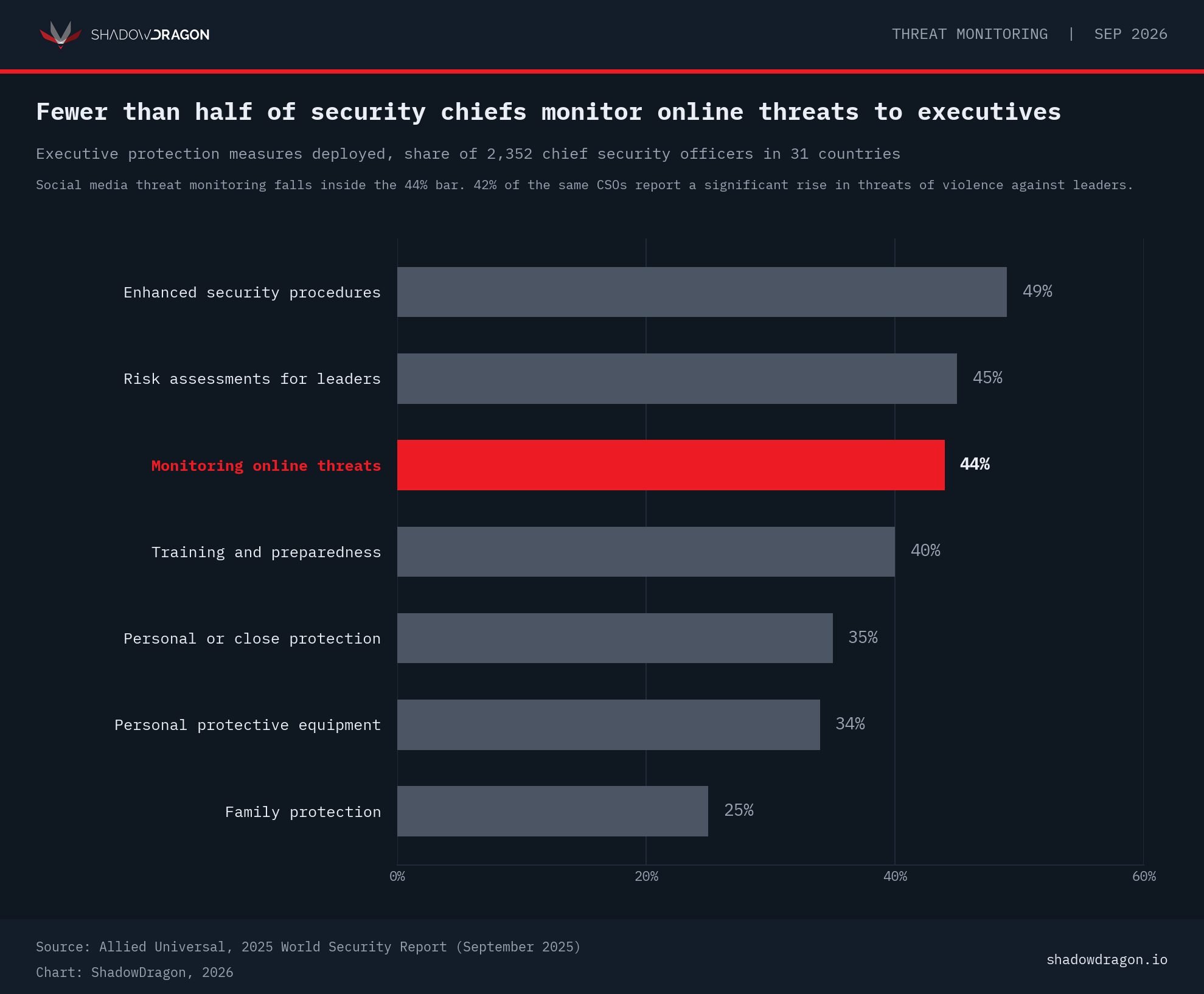
Social media threat monitoring is still missing from most executive protection programs. Only 44% of chief security officers monitor online threats, even though 42% report a significant rise in threats of violence against company leaders, according to the 2025 World Security Report from Allied Universal.
Social media threat monitoring is the continuous tracking and analysis of public social networks, messaging apps and forums to detect physical, cyber, brand and reputational threats. Security teams use it to find direct threats, imposter accounts, doxxing and coordinated harassment before they escalate.
This guide covers the main threat types, 10 monitoring strategies you can put in place this quarter and three documented cases where monitoring stopped harm.
Social media threat intelligence is the analyzed, actionable output of social media threat monitoring. It answers three questions: who is making a threat, how credible it is and what to do next. Analysts use social media threat intelligence to attribute anonymous accounts, map networks of associates, judge escalation risk and brief decision makers. It is used by law enforcement, fusion centers, corporate security and executive protection teams.
Dr. Lina Alathari, chief of the National Threat Assessment Center, summarized the finding to CBS News:
“There is no community that is immune from this. But we do see commonalities that will help us with prevention.”
– Dr. Lina Alathari, Chief, U.S. Secret Service National Threat Assessment Center. CBS News, January 2023. Source
hose commonalities, including online leakage of intent, are exactly what a monitoring program is built to surface.
Types of social media threats
Social media is a tool for communication, but when misused, it is also a target and a weapon. As more people turn to social platforms for news, often without verifying facts, the spread of misinformation accelerates.
From phishing campaigns to fake news, fraud and other illicit activities, the risks are constant.
Threats come in many forms, each with the power to disrupt operations, damage reputations, cause financial loss or endanger lives.
Cyber threats
Social media platforms are fertile ground for cyber threats like phishing schemes, malware distribution and account hacking. Cybercriminals exploit messaging features and fake profiles to send malicious links or attachments, often disguised as legitimate communication. Once clicked, these payloads can compromise personal data, install spyware or grant remote access to sensitive systems.
Using publicly available information and follow-on OSINT lets investigators examine the person behind the keyboard while mapping the exploits and cyber data that reveal the activity.
Brand threats
Impersonation and fake accounts pose a significant risk to a company’s reputation. Bad actors impersonate company leaders or corporate profiles to deceive customers, initiate fraudulent activity or spread false information.
Nisos found that 15% of executives were targeted by social media imposter accounts across 72 executive vulnerability assessments in its 2026 Executive Digital Exposure Trends Report. Defamatory content from unhappy individuals or organized disinformation efforts spreads rapidly and shapes public opinion before brands can respond.
OSINT tools can help detect these threats early by identifying impersonated or fake accounts quickly, enabling faster response, mitigation and stronger brand protection.
Ryan LaSalle, CEO of Nisos, put the shift this way when the report was released:
“The challenge isn’t that executives are suddenly sharing more information; it’s that the technology available to threat actors has fundamentally changed.”
– Ryan LaSalle, CEO, Nisos. Nisos, 2026 Executive Digital Exposure Trends Report, July 2026. Source
Monitoring has to keep pace with that technology, which is why the strategies below lean on automation rather than manual review.
Misinformation and fake news
False narratives, propaganda and manipulated media thrive on social media and gain attention fast. Hoaxes and fake news can spark anger or panic, manipulate markets and skew public opinion.
Posts containing violent threats, extremist rhetoric or references to planned attacks frequently surface on social platforms before real-world action. Child grooming and human trafficking activity are also common on social media platforms.
Tracking this content is an essential step in detecting early indicators of terrorism, organized criminal conduct or mass violence. Social media intelligence (SOCMINT) is a core tool for law enforcement agencies that need to identify and evaluate physical and digital threats.
Compliance risks
Improper use of social media can result in legal issues and regulatory penalties. Compliance breaches occur through sharing confidential or classified data, violating advertising guidelines or mishandling user information.
The healthcare and finance sectors face heightened risk because they operate under rigorous regulatory standards.
10 effective strategies for social media threat monitoring
Social media threats evolve in real time, spread fast and cross platforms without warning. Staying ahead of everything from disinformation to direct physical threats requires strategy, precision and the right tools and OSINT techniques.
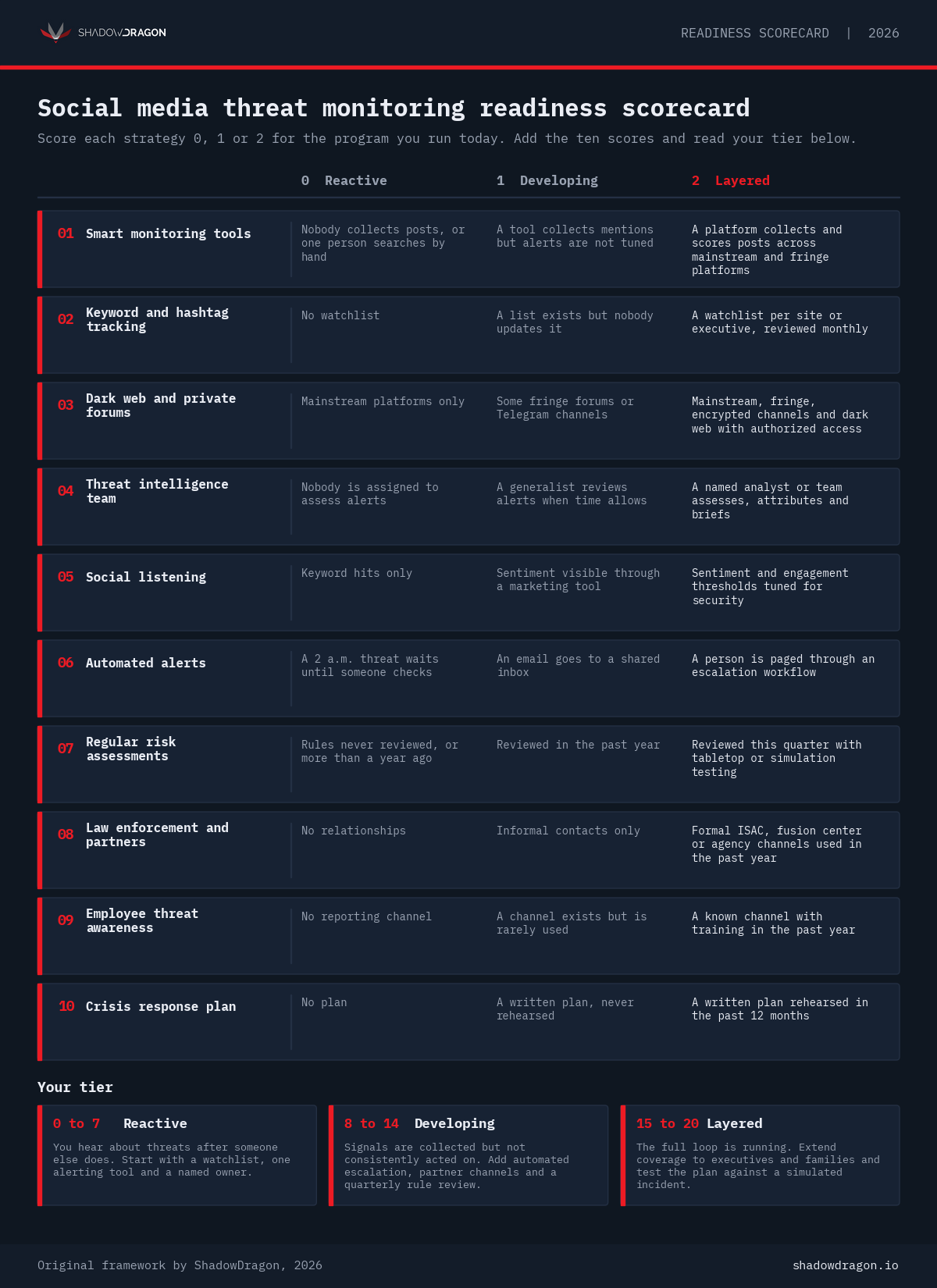
The following strategies build a layered social media threat monitoring approach: awareness, preparation and rapid response when threats become real.
1) Implement smart monitoring tools
Smart monitoring tools are the foundation of social media threat monitoring because the volume of posts is too large for manual review. These tools detect anomalies and behavioral patterns that show hostile activity, from coordinated disinformation campaigns to lone-actor threats.
Effective systems filter out noise, prioritize relevance and enable rapid assessment. ShadowDragon® Horizon® Monitor identifies early threat indicators such as changes in sentiment language, rapid follower growth and the appearance of high-risk keywords. ShadowDragon® SocialNet® lets investigators map identities, identify connections, track digital breadcrumbs and visualize networks of associates.
Beyond tracking trending topics, keyword and hashtag monitoring can detect escalation indicators. Teams use targeted watchlists to identify calls to action, radicalizing speech or leaked internal details.
Tailor your lists for location, language (slang, jargon) and context, and update them often. Shadow accounts and obscure slang require ongoing refinement for effective monitoring.
3) Monitor news, dark web and private forums together
Companies monitor emerging threats across news, social media and dark web sources by running one watchlist against all three at once, so a name that surfaces in a Telegram channel triggers the same alert as a name in a news story.
Successful monitoring of these publicly available information sources depends on authorized access and on automated filtering that separates meaningful signals from noise.
4) Establish a threat intelligence team
Automated tools do not replace human judgment. A capable threat intelligence team excels at contextualizing alerts, mapping adversarial networks and verifying information sources.
To perform effective threat analysis, analysts need to study platform-specific behaviors while understanding threat actor tactics and local socio-political factors. Intelligence is only useful when it is accurate, timely and actionable.
5) Use social listening tools
Social listening platforms go beyond simple mention tracking to reveal sentiment changes, rising unrest and user behavior anomalies. Combined with OSINT frameworks, these tools let analysts detect soft signals before they become serious threats.
Investigators use them to assess changes in tone, spikes in engagement and meme spread across communities.
6) Automate alerts for immediate response
Response time matters. Delays create openings for damage.
Build automated alerting workflows tied to escalation procedures. When threat indicators reach pre-defined thresholds, such as volume, virality or velocity, alerts should trigger a response from cross-functional teams.
Do not rely on manual review. Integrate your systems with existing ticketing software or threat intelligence platforms to achieve faster response times.
7) Conduct regular risk assessments
Threats change constantly. The high-risk issues of six months ago have become today’s background noise.
Review threat vectors, adversarial tactics and platform vulnerabilities on a regular basis and update monitoring rules accordingly. Test the most severe threat scenarios and run attack simulations to find hidden gaps in your coverage.
8) Collaborate with law enforcement and cybersecurity firms
Threat monitoring should not happen in a vacuum. Establish operational partnerships with law enforcement agencies, information sharing and analysis centers (ISACs) and private cybersecurity firms.
Working with partners boosts visibility and strengthens attribution, which leads to faster takedowns. ShadowDragon® SocialNet® delivers network mapping to facilitate collaborative investigations and intelligence exchange.
9) Educate employees and users on threat awareness
Your workforce is both your weakest link and your first line of defense. Educate your team to identify phishing attacks, suspicious social media content and misinformation operations.
Critical thinking is vital to any team’s security. Taking an extra second to examine a URL before clicking can save money and confidential information. It can also stop a group seeking access to your systems.
Establish clear channels for reporting suspicious online content. Internal awareness enables faster and more precise threat response.
10) Develop a crisis response plan
An effective response plan is critical when a threat materializes. A complete crisis response plan defines roles and responsibilities, communication channels, legal review and stakeholder communication.
Create response plans for platform takedowns, brand impersonation and physical threats. Rehearse the plan and update it regularly. There is no time to prepare when threats are imminent and you need to act.
Score your program against the 10 strategies above. Original framework by ShadowDragon, 2026.
Social media threat monitoring for executives
Social media threat monitoring for executives covers the CEO, board members, spokespeople and their immediate families, because attackers target the people around a leader as often as the leader.
Nisos reviewed 72 executive vulnerability assessments for its 2026 Executive Digital Exposure Trends Report and found that 94% of executives had a home address publicly linked to their name, 69% had public social media accounts revealing personal or family information and 15% were targeted by social media imposter accounts.
Monitor four things for each protected person:
Direct threats and hostile mentions by name
Imposter accounts using their photo or title
Doxxing posts that publish addresses or travel plans
Family accounts that leak location
Run a keyword watchlist per executive, add their aliases and nicknames and alert on velocity spikes rather than single posts. Pair the watchlist with an OSINT social media search to find accounts that mention the executive without tagging them.
Steve Jones, global chairman and CEO of Allied Universal, framed the risk when the World Security Report was published:
“In a world of increasing polarization, and when mistruths and untruths can be shared instantaneously, companies and their senior leaders face heightened risks.” – Steve Jones, Global Chairman and CEO, Allied Universal. 2025 World Security Report press release, September 2025. Source
The 44% figure at the top of this guide shows how few programs have closed that gap. The section below shows how a small team can start.
How small security teams monitor threats without a GSOC
Small security teams can monitor global threats in real time without a GSOC by narrowing collection to a short watchlist, automating the first pass and borrowing capacity from partners.
Start with 20 to 50 terms: facility names, executive names, product names, known threat actor handles and local slang for violence. Feed the list into a monitoring tool that alerts on new matches in real time, so nobody has to watch a dashboard.
Set a three-tier triage rule:
Direct threats page a person immediately
Hostile mentions go to a daily review
Background chatter goes to a weekly summary
Join the relevant ISAC or fusion center to receive threat bulletins you did not have to collect yourself. Use free OSINT tools for pivots and verification before paying for a platform.
A two-person team running this loop covers more ground than a ten-person team reading feeds by hand.
Examples of successful social media threat mitigation
Examples of social media threats include direct threats of violence against schools or workplaces, coordinated harassment campaigns, imposter accounts impersonating executives, phishing links sent through direct messages, deepfake videos of company leaders, doxxing posts that publish home addresses and extremist recruitment in private groups.
The three social media threat monitoring examples below show teams catching threats like these before harm occurred.
1) NCAA pilot program targets harassment with AI monitoring
In a pilot study, the NCAA deployed AI-powered monitoring tools to detect harassment against athletes, coaches and officials across social platforms. The system scanned posts in real time, flagging abusive content based on sentiment shifts, specific keywords and behavioral patterns.
The program identified threats early and provided evidence for follow-up action, helping schools and law enforcement intervene before incidents escalated.
2) USPS analytics team tracks illicit online activity
The United States Postal Inspection Service (USPIS) maintains a specialized Analytics Team, formerly known as the Internet Covert Operations Program (iCOP), tasked with identifying illegal activity across social media and the dark web.
This group monitors open platforms, encrypted apps and black markets for threats related to mail-based crimes, fraud and violence. In several cases, USPS intelligence has led to arrests tied to counterfeit postage, narcotics trafficking and coordinated scams.
3) Brooklyn teen arrested after TikTok threats against schools
A Brooklyn teenager was arrested after posting threats targeting schools in Texas and Florida via TikTok. Local law enforcement, acting on digital evidence surfaced through platform monitoring and cross-jurisdictional tips, traced the source and made the arrest before any violence occurred.
The case shows how fast threats spread and how quickly coordinated monitoring and inter-agency collaboration can neutralize them.
Social platforms, OSINT tools and real-time alerts played a direct role in disrupting a potential incident before it moved offline.
Final Thoughts
Social media threats are not always obvious. They are often disguised in memes, hashtags, burner accounts and private chats. Effective threat monitoring requires precision, speed and tools built for the job.
SocialNet® and Horizon® Monitor, investigators can follow digital trails, establish identity links and reveal coordinated threats that operate in both visible and hidden networks.
Contact us for a demo to learn how ShadowDragon® can help your team stay ahead of social media threats.
Frequently asked questions
What’s the difference between social listening and social media threat monitoring?
Social listening tracks brand mentions and sentiment for marketing insight.
Social media threat monitoring focuses on security risks such as cyber threats, disinformation and violent content.
Why is social media threat monitoring important?
Social media threat monitoring helps organizations detect early signs of cyberattacks, brand impersonation, misinformation and physical threats. It enables faster response and reduces reputational, legal and safety risks.
How can businesses detect fake accounts and impersonations?
Businesses use automated monitoring tools or ‘passive collection’ to analyze username patterns, follower behavior, image reuse and engagement anomalies. Flagged profiles can be cross-verified against official accounts to confirm authenticity and escalate for takedown.
How should organizations respond to a social media threat?
Organizations should have a response plan that includes verifying the threat, assessing severity, escalating to relevant teams (e.g., legal, security, PR) and coordinating with platform providers for removal or mitigation. Documentation and internal communication are critical throughout the process.
Can you go to jail for threatening someone on social media?
Yes. Threatening someone on social media can lead to criminal charges and jail time in the United States.
Under federal law, 18 U.S.C. § 875(c), transmitting a threat to injure another person across state lines, which includes most internet posts, carries up to five years in prison.
In Counterman v. Colorado (2023), the U.S. Supreme Court held that prosecutors must show the poster acted at least recklessly, meaning they consciously disregarded a substantial risk that the message would be read as threatening.
Most states also charge online threats under harassment, stalking or terroristic threat statutes.
This answer is general information, not legal advice.
How do you know if your social media is being monitored?
You usually cannot tell when a public social media post is being monitored, because monitoring tools collect public content without interacting with the account. Anything posted publicly can be read by any person, organization or software, including law enforcement and corporate security teams.
Signs that an account itself has been accessed, rather than observed, are different:
Unfamiliar login alerts
New linked devices
Changed recovery details
Messages you did not send
Legitimate threat monitoring programs collect only publicly available information and follow platform terms of service.
What is the best social media monitoring tool for threat detection?
The best social media monitoring tool depends on who is doing the monitoring.
Corporate security and threat intelligence teams typically need continuous alerting across mainstream platforms, fringe forums and the dark web, which is what Horizon® Monitor provides.
Developers building threat detection into their own systems use the SocialNet® API.
Teams with no budget can start with ShadowDragon’s free OSINT tools for pivots and verification. Agencies monitoring for terrorist activity or extremist recruitment should prioritize tools with fringe platform and encrypted channel coverage plus lawful, authorized access.
Post Author
Nico Dekens – aka “Dutch OSINT Guy”
Senior VP of Engineering and Chief Innovator
Nico Dekens is an experienced all-source intelligence analyst and the founder of Dutch Osint Guy Intelligence Services, specializing in Open Source Intelligence (OSINT), online Human Intelligence (HUMINT), and digital investigations. With a deep passion for intelligence gathering, analysis, and online investigations, Nico has dedicated over 20 years to the field, including extensive experience within Dutch law enforcement.
Throughout his career, he has worked on a wide range of cases, from high-profile homicide and international narcotics investigations to tracking stolen art, gang violence, and online extremist networks. He has also conducted covert virtual HUMINT operations and counterterrorism investigations.
Related
12 best OSINT username lookup tools for investigators
 Nico Dekens – aka “Dutch OSINT Guy”