
OSINT Framework: What is a better alternative?

headshot of Nico Dekens – aka “Dutch OSINT Guy”Nico Dekens – aka “Dutch OSINT Guy”
28 Aug 2026
OSINT analyst reviewing data on multiple computer screens while referencing a printed diagram during an investigation

The OSINT Framework at osintframework.com is a free, categorized directory of open source intelligence (OSINT) tools. It serves as a useful starting reference, but it is not an investigation platform. Analysts who have more complex investigative demands are better served by an approach that pairs a maintained free toolkit with a professional platform capable of automating collection, correlating results and producing a report.

This distinction is why analysts look for an alternative. The OSINT Framework points to tools; it does not run them, connect their results or move a case forward. Every step still has to be performed by hand.

This guide explains what the OSINT Framework is, where its limitations lie and how the Horizon® platform functions as a professionally maintained, end-to-end alternative.
What the OSINT Framework is

The OSINT Framework is a free, community-maintained directory of OSINT tools published at osintframework.com. It arranges resources as a branching tree: you start from a category such as username, email address or domain name, then expand branches until you reach a link to a specific tool or website. Nothing is installed and nothing is paid.

People use it for good reasons. It is free, it is organized by task and it gives a newcomer a fast sense of what categories of OSINT work exist. When you are learning where to look, a labeled directory of hundreds of entries offers a decent baseline.

Its value lies in orientation. The OSINT Framework indicates that a given class of tool exists and roughly what it does. Treated as an index rather than an engine, it fulfills that function well.

Where the OSINT Framework falls short

The OSINT Framework’s core limitation is structural: it is a static directory, not a working tool. It directs analysts to third-party links and stops there. Every limitation that follows is a consequence of that single design choice.

  • Links go stale. Because the directory depends on external sites that move, rebrand or shut down, a portion of any large link tree will eventually point to a dead page or a changed service.
  • Maintenance depends on volunteers. No directory maintained this way can keep pace with the open web indefinitely.
  • There is no automation. Each tool must be opened in a new tab, queried by hand and its results copied before moving to the next. Since the directory cannot run a query or return combined output, the pace of the work is limited by analyst effort rather than the scope of the case.
  • There is no correlation. When one tool returns an email address and another returns a username, the OSINT Framework does not connect them. That relationship has to be tracked manually, in notes or a spreadsheet, rather than surfaced automatically. Link analysis is reconstructed from memory rather than visualized on screen.
  • It lacks case management capabilities. The directory does not log queries, save findings or generate a report a colleague could follow. For casework headed toward a legal filing, a hiring decision or an executive briefing, that gap in documentation is a genuine liability.

What to look for in an alternative

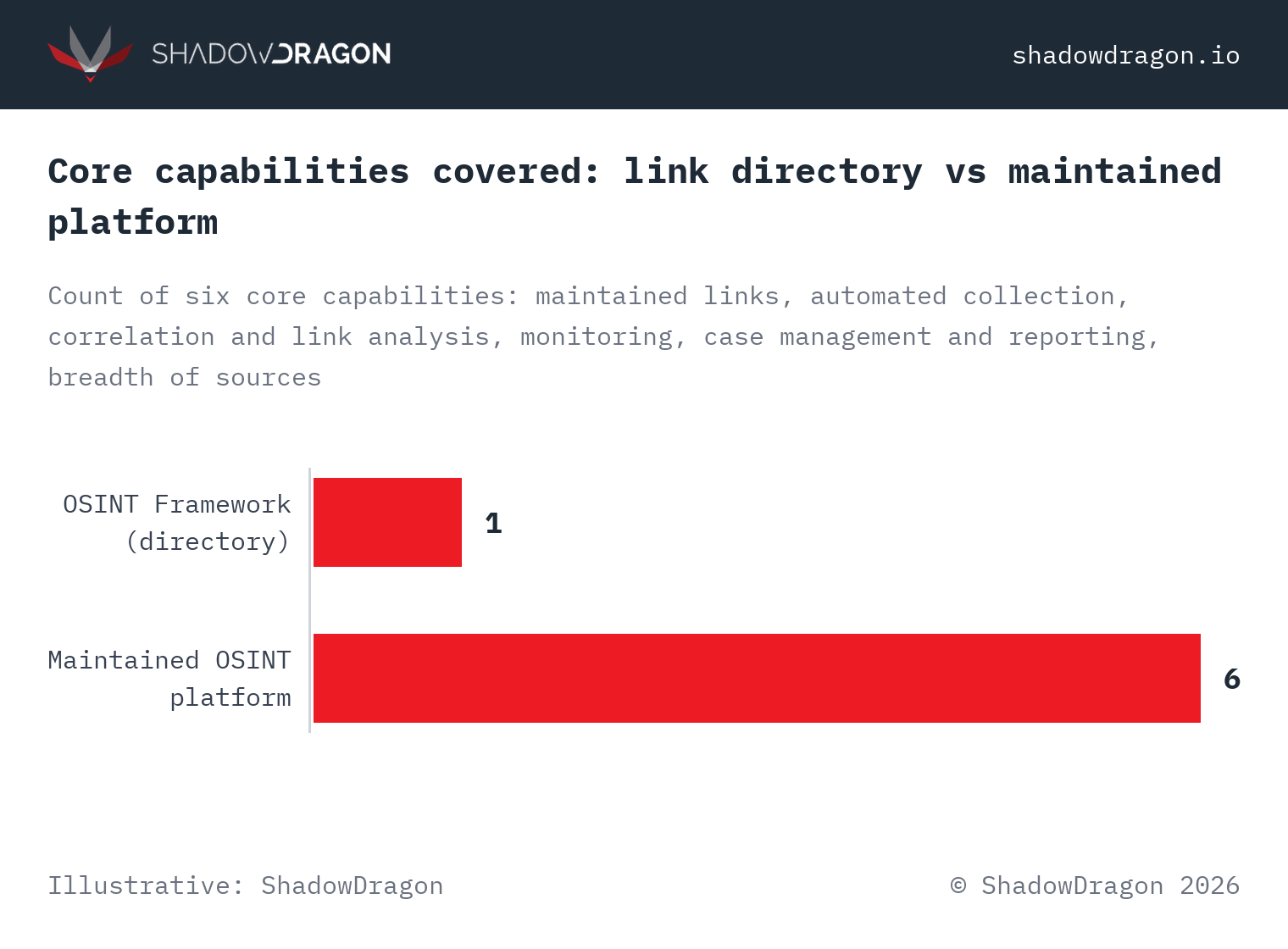
A stronger alternative to the OSINT Framework addresses the entire investigation, not just the index of tools. The strongest options answer six questions the directory leaves unresolved:

  1. Are the tools maintained?
  2. Is collection automated?
  3. Are results correlated?
  4. Can change be monitored?
  5. Can a case be documented?
  6. How broad is source coverage?

Maintenance comes first. A curated, supported toolkit means an analyst is not responsible for quality-assuring a wall of external links, since someone else keeps the set current and removes what breaks.

Automation and correlation follow. The goal is a platform that queries many sources simultaneously, then maps the connections between entities so an email, a username and a profile appear on a single graph rather than across a dozen browser tabs.

Monitoring and documentation complete the picture. Subjects change behavior, open new accounts and delete old ones, so evidence gathered can easily be outdated within a short time frame without an alerting mechanism in place. Reporting and case management then convert findings into something repeatable and defensible.

ShadowDragon® as a maintained alternative

ShadowDragon® offers a professionally supported, dynamic alternative to static directories of links. The Horizon® platform was built to run collection, correlation, monitoring and reporting within a single browser-based workspace, consolidating the manual steps a directory leaves to the analyst into one guided workflow.

Breadth is the foundation. Horizon® Identity resolves identities and maps networks across 600+ data sources, delivering coverage that a hand-run list of individual tools cannot match. A single query surfaces where accounts exist and a subject is active, rather than requiring sites to be checked one at a time.

Correlation sets the platform apart. The Horizon® platform allows for pivots between entities on a visual graph: an email exposes a username, a username leads to a profile, and a profile leads to a second account, with each connection mapped as the investigation progresses. Horizon Monitor® then allows for tracking open internet sources over time and alerts analysts to change, keeping a case current without daily manual review.

Reporting closes the loop. The Horizon® platform documents the investigation and produces output that a colleague or a court can follow. Data is not retained once it has been deleted or made private. The comparison below reviews the directory approach against the platform approach across the capabilities that determine whether findings hold up under scrutiny.

Free versus professional options

Choosing between free and professional tools depends upon the requirements of the investigation. The practical approach is a free toolkit for quick work and a professional platform for cases with depth and significance, rather than relying on a static directory for either.

For light touch investigative work, ShadowDragon®’s free OSINT tools hub offers an alternative to a link directory. It hosts working tools that run directly in the browser, including the Dork Assistant for building search operators, along with an Email Permutator, Image Forensics, Open Sources Toolkit and a Checklist Generator. For a broader overview, our guide to the best OSINT tools explains where each type fits.

Free and open source tools worth knowing

Several free and open source tools perform genuine collection that analysts can use. Each handles a single slice of an investigation, which leaves correlation to the analyst.

theHarvester gathers names, emails, IP addresses, subdomains and URLs about a domain from public sources during reconnaissance. Sherlock identifies accounts by username across more than 400 social networks. Recon-ng is a modular web reconnaissance framework with a command-line interface for gathering information from open sources efficiently.

These are strong point tools, but each are independent and manually stitched together with the others’ results. A comprehensive OSINT platform performs that class of collection automatically and connects the output on a single graph, the difference that free tools leave for the analyst to complete.

Frequently asked questions

Is the OSINT Framework still useful?

Yes, as an index. The OSINT Framework is a good way to learn what categories of OSINT tools exist and to browse options by task. It becomes a more challenging fit once you need automation, correlation, monitoring or reporting, because it’s a directory of links rather than a functioning investigative tool.

Why do OSINT Framework links stop working?

The directory points to third-party sites that move, rebrand or shut down over time. Because upkeep relies on volunteers, dead links accumulate faster than a small team can prune them. An actively maintained toolkit avoids this by hosting and supporting the tools directly.

What is a good free alternative to the OSINT Framework?

An actively maintained set of free, browser-based tools is a stronger free option than a static directory. Our free OSINT tools hub hosts working utilities such as the Dork Assistant, an Email Permutator and Image Forensics, keeping them current rather than linking out to sites that may have changed.

How is ShadowDragon® different from the OSINT Framework?

The OSINT Framework lists tools; ShadowDragon® runs them. The Horizon® platform automates collection across 600+ data sources, correlates entities on a visual graph, monitors subjects over time and produces a documented report. The directory leaves each of those steps to the analyst.

Does ShadowDragon® store subject data after it is deleted?

No. ShadowDragon® does not retain data once it is deleted or made private. Your investigation reflects what is publicly available at the time of collection. We do not scrape or store any data.

Ready to see the difference?

When a directory of links has taken an investigation as far as it can go, a comprehensive OSINT  platform offers a clear next step. The Horizon® platform automates collection across 600+ data sources, correlates entities, monitors change and produces a defensible report, freeing analyst time for judgment rather than tab management. Request a demo of the Horizon® platform and see how it handles a case of your own.