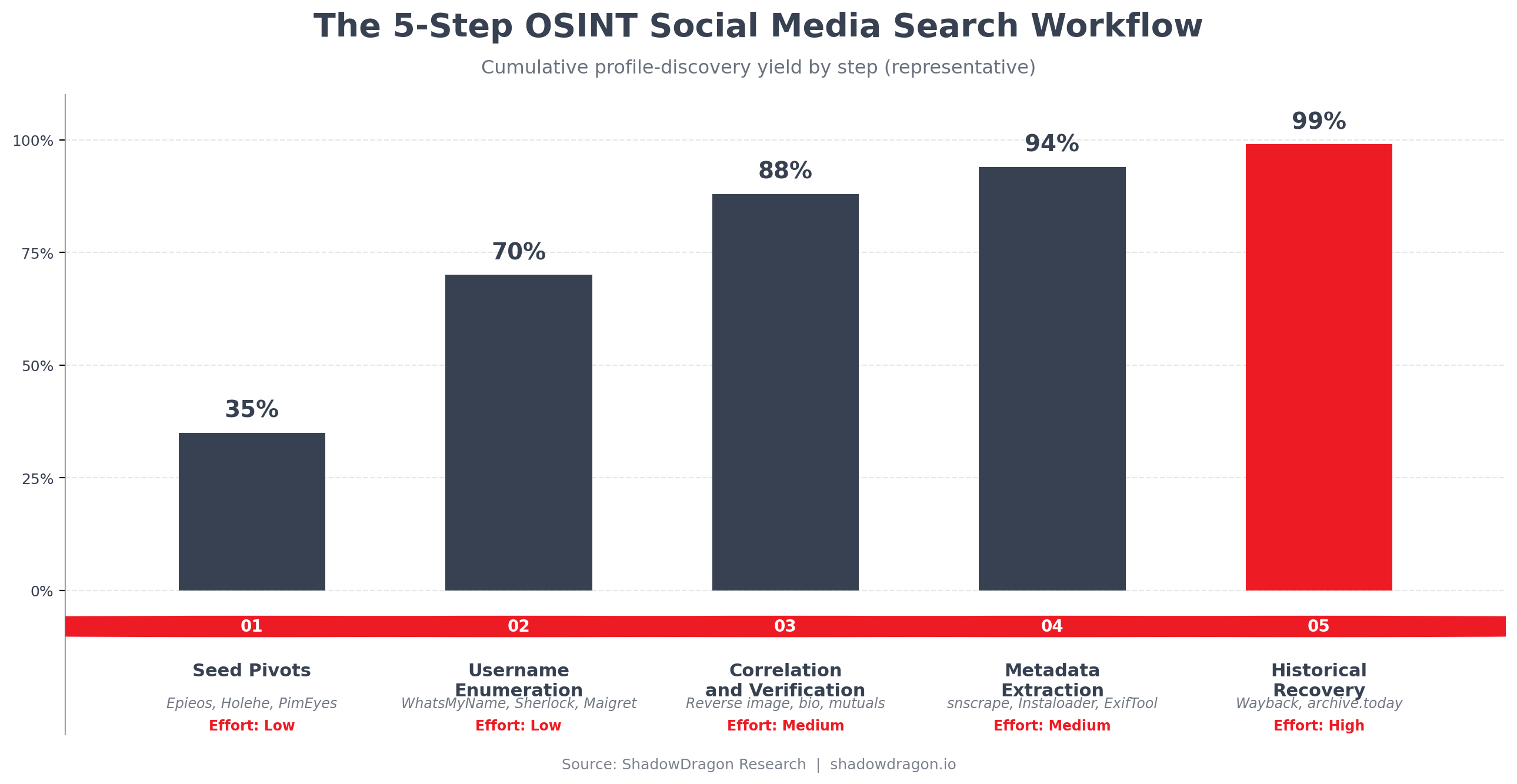
Step 5 is the professional investigator’s step that can be a differentiator when subjects delete information, social accounts get made private or posts are deleted after going viral.
Visit the Wayback Machine from the Internet Archive first. Paste the profile URL into the search box and look for archive snapshots. The Wayback Machine often archives bios and post listings from several years prior to before the subject wiped their profile. The second stop is archive.today. It’s another archive operated with a different web crawler, so it may have snapshots the Wayback doesn’t.
Eliot Higgins, founder of Bellingcat, summarized the broader principle in Time magazine:
“Scattered across the globe, we are an online collective, investigating war crimes and picking apart disinformation, basing our findings on clues that are openly available on the Internet, in social media postings, in leaked databases, in free satellite maps. We have no agenda but we do have a credo: evidence exists and falsehoods exist, and people still care about the difference.”
Higgins and his team have employed archive retrieval, as described in this section, to expose Russian military intelligence officers, authenticate war crime videos and map disinformation campaigns. It’s the same process a corporate investigator leverages to rebuild a threat actor’s deleted activities.
Since Google retired their cache feature back in 2024, use site specific search operators against the live wayback index as well as open telegram and Discord archives which often re-publish viral content.
For fully privatized accounts, the recourse is to search data collected by third parties. Subreddits, Discord servers, and Telegram channels often preserve accounts, serving as a public record. Journalists and researchers also rely on these archived copies for evidence when a subject deletes evidence.
When investigations are active for weeks or months, deletions are an ongoing concern, so investigators use a real time monitoring service. Instead of manually checking accounts, monitoring tools allow for notifications to alert on posts, edits, or deletions. For one-off investigations, the free archive utilities are typically sufficient. ShadowDragon®’s Horizon Monitor® offers this support for enterprise teams.
Is OSINT social media search legal?
Searching and recording information that is publicly available on social media is legal for investigators, journalists and consumers in most jurisdictions. An investigator crosses the line if they view a private account without the consent of the account holder, obtain information behind a login wall using credential stuffing or session hijacking, or impersonate another person to view protected information. Legitimate OSINT professionals stick to public information, document every step of their collection process for chain of custody purposes, and cease activities the moment they learn a particular technique would violate the target platform’s terms of service.
“We are professionalising, we are giving more training, we are talking more about ethics, we are talking more about what you can do but more importantly what you should not do when it comes to this profession.” – Nico Dekens (Dutch OSINT Guy), Senior SANS Instructor and ShadowDragon® contributor, on Black Dot Solutions’ OSINT podcast, 2025.
 Nico Dekens – aka “Dutch OSINT Guy”