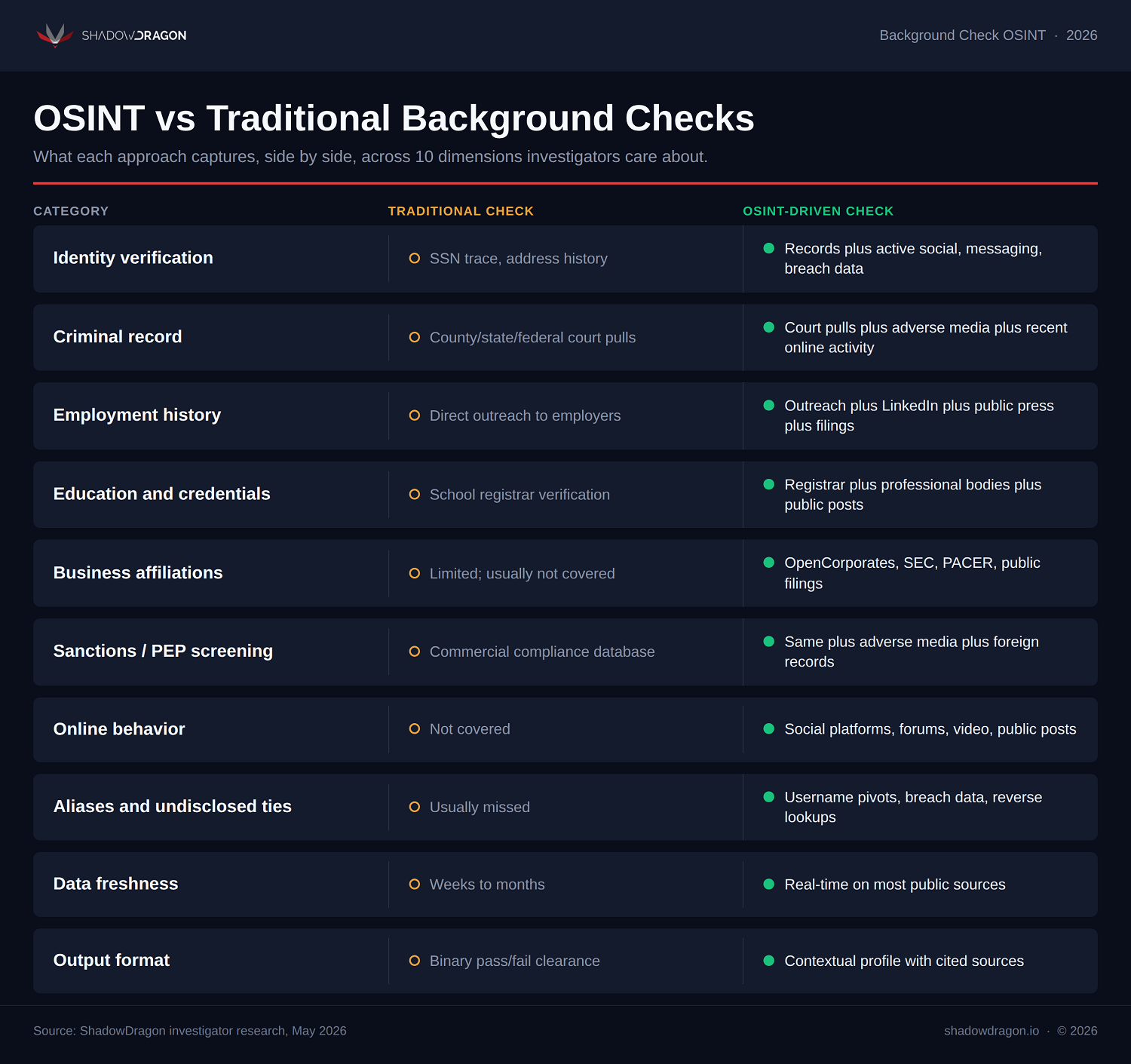
A thorough OSINT background check should be methodical, documented, and reproducible. Below is a 10 step workflow that can be scaled from a cursory vendor screen all the way up to a comprehensive pre-acquisition due diligence file.
1. Define the scope and legal basis
Prior to your first search query, write down why you are running the check, what decision it will inform, and lawful basis for doing so. Employment screenings are governed by the Fair Credit Reporting Act (FCRA). Financial services checks fall under KYC and AML regulations. EU and UK citizen data is protected by Global Data Protection Regulation (GDPR). California residents are protected by the California Consumer Privacy Act (CCPA). Collecting information outside of your defined scope/lawful basis is the fastest way to open yourself up to legal liability.
2. Capture the subject’s known identifiers
Compile any and all identifiers that you know about the subject: legal name, SSN, alias, date of birth, previous addresses, email addresses, phone numbers, past employers, claimed certifications/licenses. The more reliable data you can compile here, the less false positives you’ll have later.
3. Verify identity through public records
You want to rule out the subject being a completely synthetic identity. Search the name and known addresses against business registrations, property records, voter records (if public), and court records. Matches across multiple independent sources is a good way to confirm an individual exists.
4. Search public legal and regulatory records
Include the federal and state court system if there is a searchable database. Also look at sanctions lists/watchlists (OFAC, UN, EU Consolidated List), politically exposed persons (PEP) lists, and any applicable licensing boards for whatever purported credentials the subject claims to have. Document any hits with the URL and date of your search.
5. Confirm business affiliations and ownership
Look through OpenCorporates, Secretary of State sites for every state the subject has claimed to conduct business in, SEC filings, beneficial ownership databases if available, and government contracting websites. Hidden affiliations are often the most valuable discovery.
6. Investigate the digital traces
Google the person’s name in quotes. Also search other search engines, like Bing, plus any major region-specific search engines. Find their LinkedIn and corroborate professional histories with what they say about themselves. Scan social networks (X, Facebook, Instagram, TikTok) for evidence of behavioral patterns, public statements, and overt relationships. Use reverse image search on profile images to see if photos have been shared by others..
7. Look for breach and leak information
Email addresses, phone numbers, and usernames appear in public breach dumps frequently. Cross-reference everything you know about the individual with breach databases to uncover past registrations, hidden accounts, and aliases. Free OSINT tools can provide you with most of the information you’ll need. Paid services will go deeper.
8. Run adverse media checks
Search news archives, blog posts, and forum threads for any mention of the subject. Adverse media could be a strong sign of fraud, regulatory investigations, and reputation risks. Ignore anonymously posted accusations; treat reporting from well-known, reputable sources as reliable
9. Cross-reference and corroborate
One source shouldn’t be sufficient for something to end up in your report. Verify every material finding with at least two independent sources. If a LinkedIn position is mentioned in both a press release and SEC filing, that’s good. If something is only mentioned on someone’s personal website, it’s insufficient.
10. Document and report
Take a timestamped screenshot of every source you find with the URL intact. Tie your final report back to the scope outlined in step 1: what was expected, what was verified, what was suspected, what was unable to be verified, what was out of scope for the engagement). Negative results should be treated with the same vigor of source-quoting as positive results.
“The strongest background checks are the ones an analyst can defend line by line. Every conclusion gets a primary source, a timestamp, and a corroborating second source. Anything less is opinion dressed up as research.”
– Justin Seitz, OSINT trainer and creator of Hunchly
 Nico Dekens – aka “Dutch OSINT Guy”