 Nico Dekens – aka “Dutch OSINT Guy”
According to the latest research published by IMARC Group, the global open- source intelligence market reached a valuation of approximately $16.7 billion in 2025. Forecast to grow at a CAGR of 26.7% through 2035, this growth rate reflects the expansion in public data and the challenges intelligence teams face in turning it into decisions.
By the time an analyst completes an exhaustive person-of-interest deep dive of social sources, court documents, breach dumps, dark web forums, certificate transparency logs and geolocation intelligence, the target’s digital activity may have changed. That disconnect between collection cadence and decision cadence is the challenge automating open source intelligence (OSINT) seeks to address.
However, automation doesn’t mean writing and running a Python script. An automated intelligence workflow is a process by which you take publicly available data “as-is” from its original sources and transform it into structured, decision-ready intelligence with minimal manual intervention that maintains legal review.
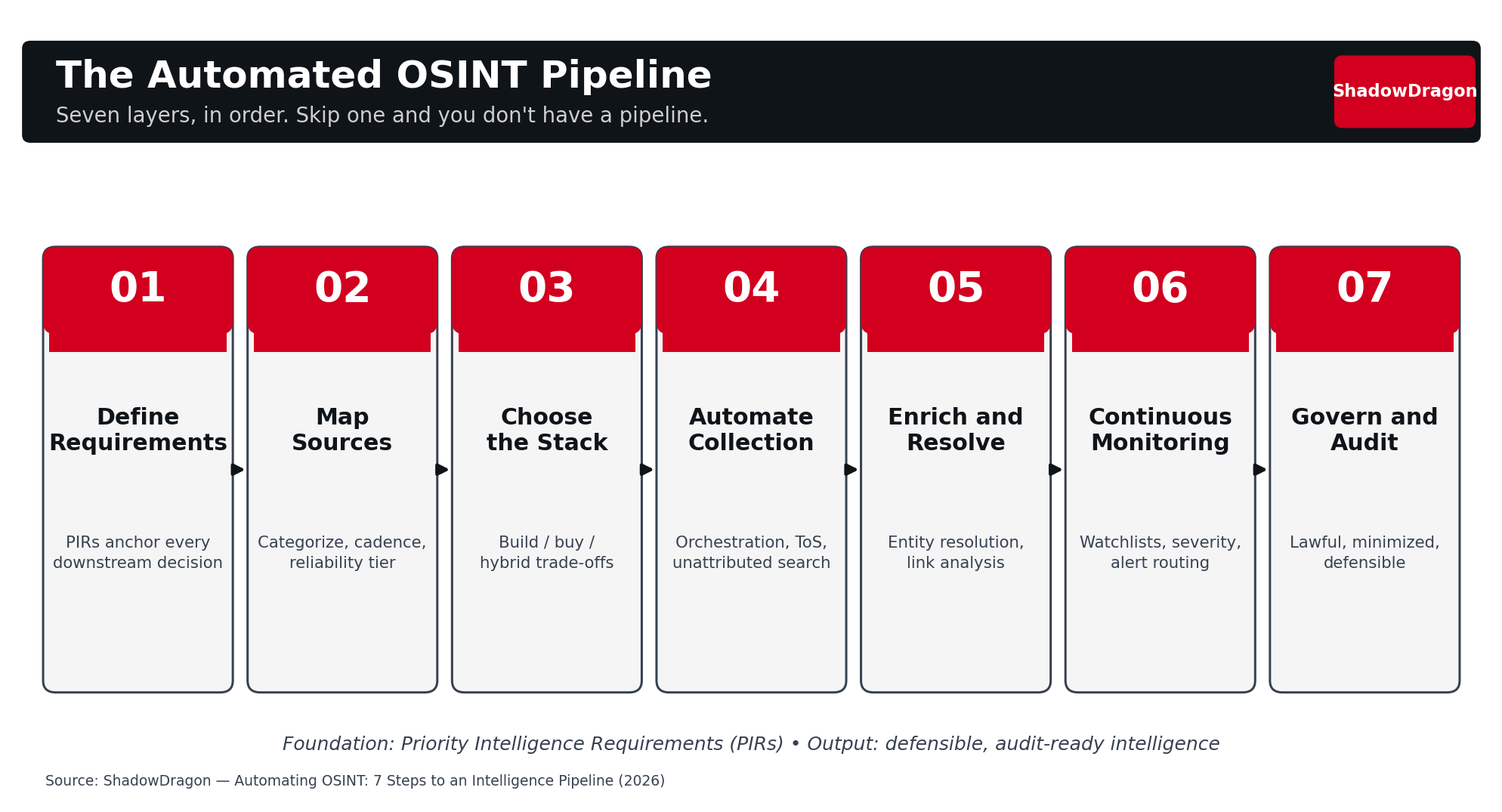
It must have requirements, sources, a tech stack, a collection layer, an enrichment layer, a monitoring layer and a governance layer. Leave any of them out and you don’t have a comprehensive process. You have a workflow that will sooner or later break, risk poor decision making, or get pulled into discovery.
Here is our seven step framework. Each step represents what an enterprise intelligence team must develop, in sequential order, to progress from ad-hoc collection to a repeatable process. Compare your present investigative process to this framework and the missing pieces will become clear.
- Define your intelligence requirements (PIRs)
- Map your OSINT data sources
- Choose your automation stack (build vs buy)
- Automate collection
- Enrich, correlate and resolve identities
- Set up continuous monitoring and alerting
- Govern (ethics, compliance and audit)