
OSINT for executive protection: reducing risk to executives

headshot of Nico Dekens – aka “Dutch OSINT Guy”Nico Dekens – aka “Dutch OSINT Guy”
14 Oct 2026
Two analysts review information on computer monitors in a security operations workspace, using OSINT for executive protection.

Open source intelligence (OSINT) gives executive protection teams reduce risk by identifying and assessing publicly available information that could be used to target the people they protect.. The concern is growing. In the 2025 World Security Report, 46% of U.S. chief security officers said the threat of violence toward executives had risen over the past two years. In the same report, 43% said they now monitor online threats as part of their response.

Executive protection OSINT is defensive work. Adversaries utilize public sources to gather information, profile and assess habits so it is important to remove those exposures so an executive and their family are harder to locate or approach, and harder to impersonate.

This guide covers what OSINT adds to an EP program, how to run pre-travel and event intelligence, how to reduce an executive’s exposed personal data and how to turn findings into protective action.
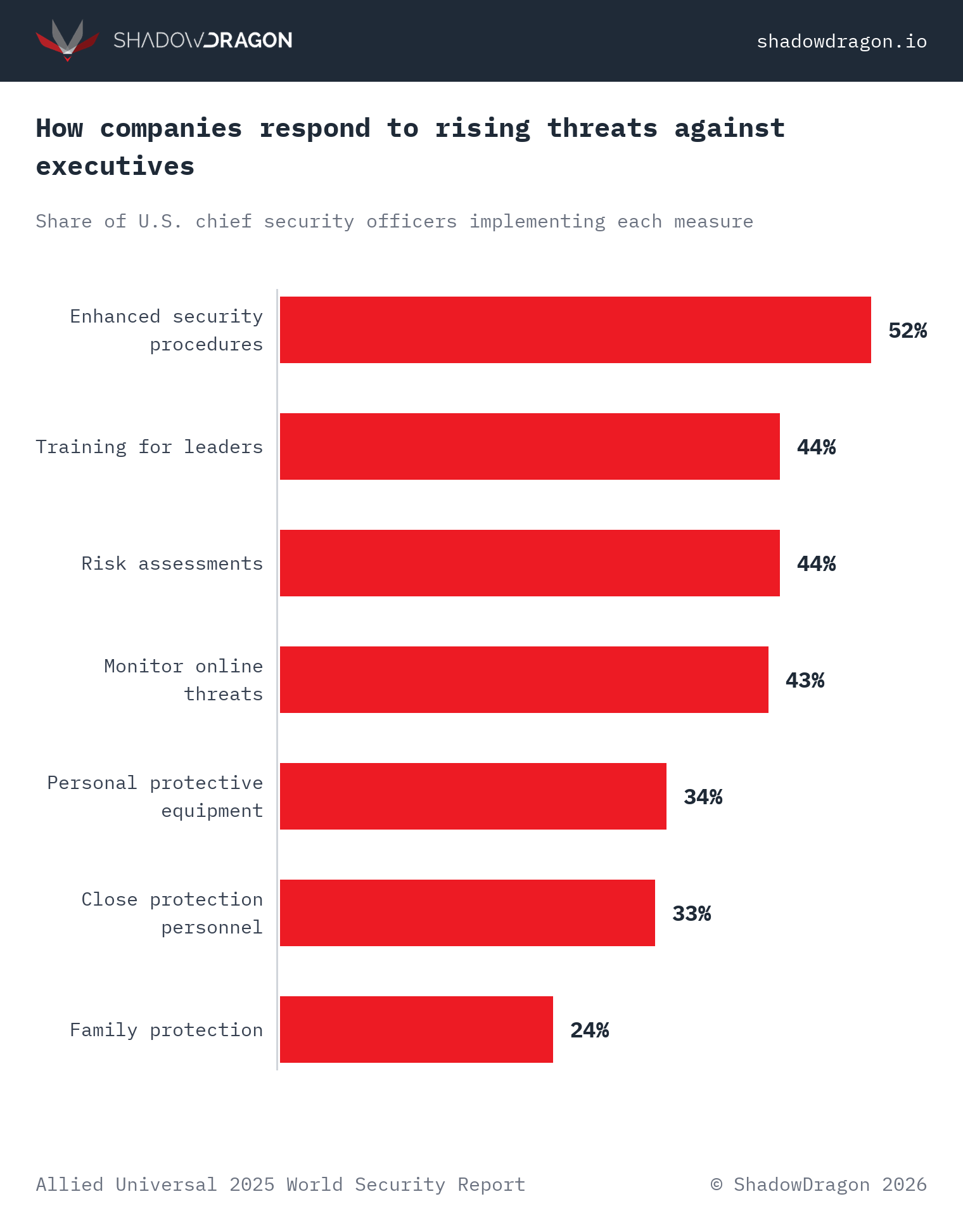
Bar chart showing U.S. chief security officers’ responses to rising executive threats: enhanced security procedures, 52%; leadership training and risk assessments, 44% each; online threat monitoring, 43%; protective equipment, 34%; close protection personnel, 33%; family protection, 24%.
Online threat monitoring complements physical protection, with 43% of U.S. security chiefs adopting it in response to rising threats against executives. Source: Allied Universal’s 2025 World Security Report.

What OSINT adds to executive protection

OSINT adds early warning to executive protection by surfacing the public information a threat actor would collect before an approach. The Allied Universal survey of 2,352 chief security officers found that online threat monitoring now ranks among the measures U.S. security teams have added alongside physical protection. Public data is where an attacker’s planning starts, so it’s also where a protective program should start.

The report’s publisher frames the shift in personal terms. Steve Jones, Global Chairman and CEO of Allied Universal, put it this way:

“Now more than ever, personal safety is on my mind and the minds of my loved ones. Professionally, I’ve seen an increase in our customers’ concern for the safety of their employees.”

– Steve Jones, Global Chairman and CEO, Allied Universal (2025 World Security Report)

That concern is why exposure reduction has moved from an optional measure to a core protective task.

A protection detail traditionally focuses on the physical: advance work and secure transport, along with close coverage. OSINT extends that coverage across publicly available sources, where an executives address and schedule may be available in plain view, and where their relationships are often visible as well. Reducing that visibility narrows the attacker’s planning options.

The discipline is defensive, both in what it aims to do and how it operates. Analysts assess risk to their own executives alongside building profiles of perpetrators. Each finding can lead to a specific protective action: a request to remove a piece of exposed information, a change to the advance plan, or, in some cases, an item the team continues to monitor over time.

Pre-travel and event intelligence

Pre-travel and event intelligence assesses destinations before an executive arrives. Teams will review protocols ahead of time and details at least a week before a major trip. Public inputs include local news, government advisories, event pages and community forums that describe conditions on the ground.

For a public appearance, teams often review the venue’s published floor plans and the event’s promoted speaker list, together with any social media posts or news sources that announce attendees. A widely advertised keynote gives an adversary a fixed time and place, so the advance plan must account for that exposure.

Analysts should map the route and the arrival point using map imagery and transit alerts, noting choke points and single access roads, as well as nearby gatherings that could delay an exit. Pre-travel OSINT turns an unvetted itinerary into a briefed one, with named risks the detail can plan around instead of just a schedule.

Reducing an executive’s exposed personal data online

Reducing an executive’s exposed personal data online starts with finding and removing home addresses, phone numbers, and family details published by data brokers. People-search sites are the best place to start, since they compile this information into a single, searchable record. These directories often list a person’s current address, relatives, and past addresses, and most charge only a small fee (or nothing at all) for full results.

Teams should begin with an exposure assessment. Analysts will find and replicate what a stranger could find. This means searching the executive’s name and known online handles, then any associated email addresses, first in standard search engines, then across people-search sites and social platforms. Targeted search operators make this process faster and more precise. ShadowDragon®’s free Dork Assistant helps analysts build these queries.

Once exposure is mapped, the team moves to removal. This includes filing opt-out requests with major data brokers and tightening privacy settings on personal accounts. Stripping geotags from public posts closes another common gap. Family members require attention too. For instance, a relative’s open profile can reveal exactly what the executive has otherwise locked down. The overall goal is simple: fewer digital traces linking the executive’s name to a home address or a daily routine.

Monitoring for threats and impersonation

Monitoring for threats and impersonation means watching open sources for direct threats and fixation signals, as well as fake accounts that use an executives name. In the 2025 World Security Report, 43% of security chiefs reported doing exactly this across social media and across the deep and dark web. Continuous monitoring surfaces problems while there is still time to act.

Threat monitoring looks for concerning language and escalating fixation on a principal, including posts that reference their location or schedule. A single hostile comment rarely matters on its own. A pattern of escalating messages from one account is a protective intelligence signal worth reviewing.

Impersonation monitoring looks for fake profiles, spoofed executive emails, and lookalike domains that borrow an executive’s name or likeness. Attackers use these to defraud staff (for example, by posing as the executive to request a wire transfer) or to post statements under the executive’s name that create reputational or even physical risk. Teams detect impersonation by tracking the executive’s name, title, and photo across social networks, then verifying each match is genuinely fraudulent before taking action.

Reading warning behaviors and protective intelligence

Protective intelligence means interpreting the warning behaviors that often precede a targeted attack, then acting before an attacker can approach the executive. This draws on behavioral threat assessment, a discipline shaped in large part by the U.S. Secret Service’s National Threat Assessment Center. Its core finding, based on decades of case research, is that people who move toward targeted violence usually show observable warning signs beforehand. They rarely act without any prior indication. OSINT is how a protection team finds those signals in open sources, before they escalate into an attack.

Teams should watch for the behaviors that threat assessment research links to movement toward violence: fixation on a principal, a grievance that hardens over time, leakage of intent in posts or private messages and probing questions about schedules or security. One angry comment is usually noise. A pattern of escalating, personalized messaging from a single account is a signal to assess.

Analysts should route each concerning finding into a documented review process, rather than treating it as a private impression to act on informally. That review should record who was involved, what was said, and when it occurred, then weigh two things: how credible the threat is, and whether the person behind it has the actual capability to carry it out. Only then should the team decide on a response. Protective intelligence works only when observation leads to a documented decision.

Residence and route risk from public data

Residence and route risk from public data comes from property records and geotagged posts, and from the map imagery that reveals where an executive lives and moves. County property records and real estate listings can name an owner and show interior photos. Teams should assume an adversary can find the executive’s home address, then plan to reduce what that knowledge yields.

For the residence, teams should check whether the property is titled directly in the executive’s name (which makes ownership easy to trace) and whether old real estate listing photos are still available online. They should also check whether publicly available maps or satellite imagery expose entry points, such as gates, driveways, or security cameras. Common fixes include moving the title into a trust or LLC to obscure ownership, and requesting removal of old listing photos from real estate sites.

For routes and routines, teams should watch for the patterns that public posts reveal. A recurring gym check-in or a school run described online exposes predictable timing, and a fitness app that shares a running route does the same. Varying routines and turning off location sharing reduce that risk. Route risk is largely a matter of predictability, and public data is what makes an executive’s activities predictable.

Turning findings into protective action

Turning findings into protective action means routing each intelligence finding into a decision rather than a report that gets filed away. Teams should use a simple loop: assess, remove, monitor and brief. The value of OSINT is measured by the risks it removes rather than the volume of data it gathers.

Teams should assess exposure on a recurring schedule, not just once. The exposure assessment should be re-run quarterly, and again before any major trip, since new personal data appears online over time and previously removed listings can resurface. Tracking findings across these assessments makes progress measurable, showing whether exposure is actually going down over time.

Teams should remove what they can and monitor what they cannot. Some data can be removed through opt-outs and privacy settings. The rest, such as news coverage or public filings, stays visible, so the team monitors it and briefs the detail. Confirmed threats and impersonations should feed into the response process: a platform report, a takedown request, a protective interview or a law enforcement referral for credible threats.

How ShadowDragon® supports executive protection teams

ShadowDragon® builds the collection and analysis tools that make this workflow practical. Two products map directly to the executive protection phases described above: Horizon Monitor® for ongoing monitoring and Horizon® Identity for exposure mapping and verification. Both run inside the Horizon® platform.

Horizon Monitor® runs ongoing monitoring and alerting on open internet data. Teams define the executives and handles they protect, and Horizon Monitor® watches for new matches so the team can react to fresh signals quickly. This is the tool that carries out the monitor step in the assess-remove-monitor-brief loop, and it feeds confirmed items into review.

Horizon® Identity handles identity resolution and network mapping across 600+ data sources. During an exposure assessment, analysts can start from a single name and pivot outward to related accounts, addresses, and relatives whose online presence is often linked to the executive’s. This pivoting is how analysts identify exactly what information needs to be removed. For a wider view of the field, our roundup of the best OSINT tools rounds out the picture with other tools in use today. ShadowDragon® does not retain data once it has been deleted or made private, so each assessment reflects only what is publicly available at that moment.

Frequently asked questions

Is OSINT for executive protection legal?

Yes. Collecting publicly available information to reduce a principal’s own exposure is a standard executive protection practice. You are reviewing open sources and your own principal’s data rather than private systems or other people’s accounts. Teams should coordinate with legal counsel on data broker removals and evidence handling.

What personal data should an executive remove first?

The home address and personal phone numbers on people-search sites should come down first, followed by family member details. These give an adversary the most direct path to a principal’s residence and routine. Data broker opt-outs and tighter social privacy settings address most of this exposure.

How often should teams run an exposure assessment?

A full assessment should run at least quarterly, and again before any high-profile trip or public appearance. New records appear constantly, so prior removals can resurface when brokers refresh their data. Running assessments on a set schedule keeps exposure levels in check over time.

Does executive protection OSINT include the principal’s family?

Yes, with consent. A relative’s open profile often reveals the home address or travel plans a principal has already locked down, and sometimes the routines as well. Family exposure reduction, done with permission, addresses one of the most common weaknesses in an executive protection program.

Can OSINT detect threats before they become physical?

Often, yes. Escalating fixation and direct threats frequently appear online first, as do posts referencing a principal’s location. Monitoring these signals gives an executive protection team time to assess intent and adjust coverage before an approach.

Build an exposure-reduction program with OSINT built for the job

Threats to executives are rising, but much of the public data that enables them is removable. A disciplined assess, remove, monitor and brief workflow, backed by broad data collection, is what makes principals and their families more difficult to target. To see how Horizon Monitor® and Horizon® Identity support executive protection, request a demo of the Horizon® platform.