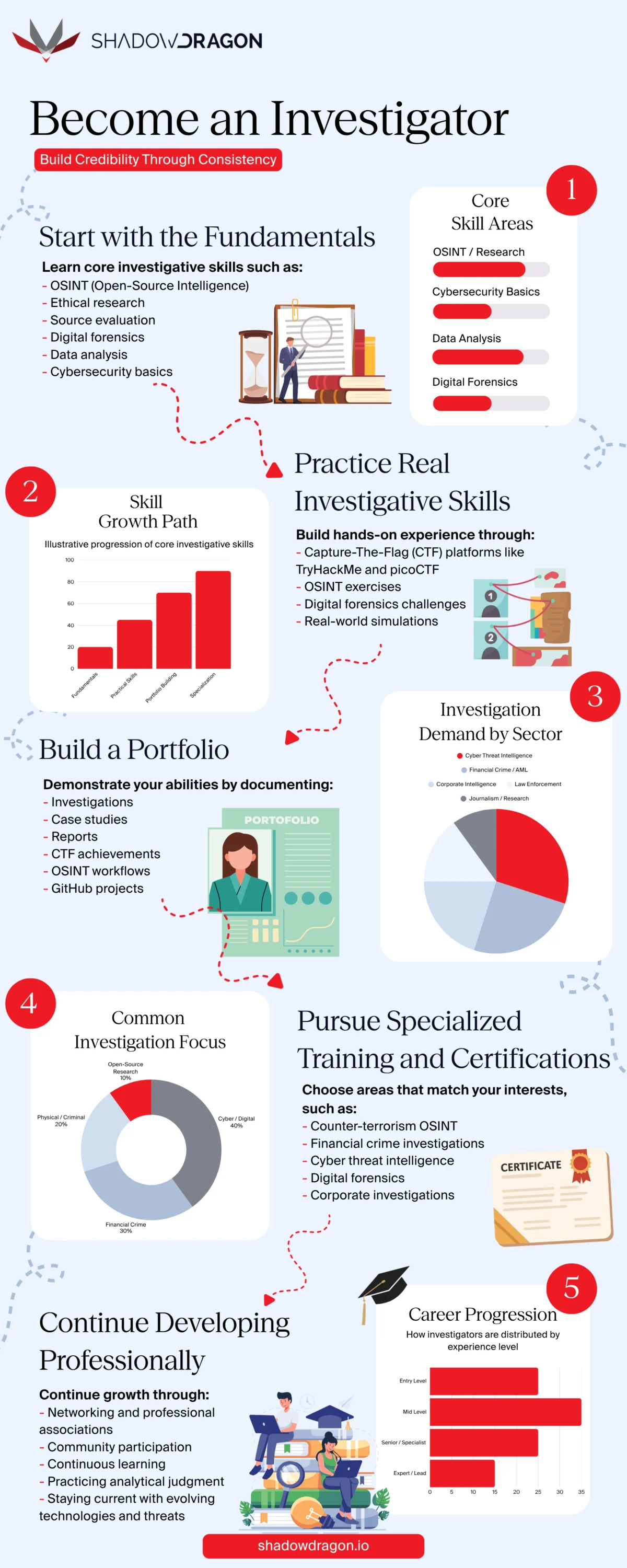
Careers in investigation continue to expand as investigative skills are utilized in more capacities in both the public and private sectors.
It’s important to note that career paths will often overlap. The skills law enforcement may utilize to investigate financial crime can also be used to help companies monitor for fraud and protect against that risk. Below are some examples of industries and specialties that utilize investigative skills.
Corporate Intelligence and Risk Management
If you have an interest in corporate intelligence and loss prevention or risk management, you can pursue many different career paths. Corporate intelligence and investigative skills are in demand as more companies look to build out in-house intelligence and investigation capabilities to manage risk and regulatory requirements.
Companies may hire staff or contract Investigators to handle intelligence and investigations; however, companies that don’t have the ability to conduct internal investigations will often look to outsource those needs. Whether it’s due diligence, third-party risk/reputation management, fraud/misconduct investigations, or compliance support, businesses will need to hire external investigatory support, which creates consulting opportunities for investigators.
Roles in corporate intelligence and risk management include:
- Corporate/Business Intelligence Analyst
- Threat Intelligence Analyst
- Corporate Loss Prevention Specialist
- Corporate Investigator
- Risk Intelligence Analyst
- Strategic Intelligence Analyst
- Corporate Fraud Investigator
- Brand Protection Analyst
- Due Diligence Analyst
- Third-Party Risk Analyst
Useful certifications and training:
Criminal Investigations / Law Enforcement
Law enforcement is one of the more traditional industries for investigators, and physical crime remains a significant concern for communities. However, digital technology has created new avenues for criminal activity, increasing both the scale and speed at which crime can occur without regard to physical distance or borders. According to the FBI’s 2024 Internet Crime Report, internet crimes resulted in losses of $16 billion, a 33% increase from 2023.
That means criminal and law enforcement investigators must now look for both physical and digital evidence to solve crimes and bring perpetrators to justice. This expands the opportunities for investigators in this field, including roles focused on one area of crime, such as homicide, narcotics, or organized crime, as well as roles for investigators who focus on digital or physical investigative practices.
Roles in criminal and law enforcement investigations include:
- Forensic Scientist
- Criminal Investigator
- Digital Forensics Investigator
- Cybercrime Investigator
- Homicide Investigator
- Narcotics Investigator
- Law Enforcement Intelligence Analyst
- Behavioral Analyst
- Organized Crime Investigator
Useful certifications and training:
- IAI Certifications (International Association for Identification) – Offers certifications in areas like bloodstain pattern analysis, forensic photography, forensic videography, latent prints, multiple crime scene certifications, firearm/toolmarks certifications, etc.
- GIAC Certified Forensic Examiner (GCFE) – Windows forensic certification that covers topics like data triage, log analysis, and web browser forensics.
- Certified Forensic Security Responder (CFSR) – Certifies you have skilled incident response capabilities. Training includes detecting cyber breach remediation and root-cause analysis.
- EnCase Certified Examiner (EnCE) – Certifies your ability to operate Opentext™ EnCase™ Forensic platform.
- EnCase Certified eDiscovery Practitioner (EnCEP) – Certifies your ability to operate OpenText™ EnCase™ Information Assurance software. eDiscovery training includes courses on planning, project management, and best practices.
- Certified Computer Examiner (CCE) – This certification is recognized across the industry as a benchmark for computer forensic examiners.
- CLEA (Certified Law Enforcement Analyst) – Certifies you have expertise in various analysis methods and intelligence production.
Financial Crime and AML Investigations
The FTC received over 2.6 million fraud reports in 2024 with reported losses totaling more than $12.5 billion. That’s 25% higher than the reported losses in 2023. This number only represents fraud that was reported to the FTC. Investigative professionals are needed now more than ever to help prevent and detect financial crime.
Businesses like financial institutions, fintech firms, cryptocurrency exchanges, and private companies all need investigators to perform due diligence, monitor transactions, monitoring, look into patterns of suspicious activity, and follow the requirements for regulations like KYC, AML, and CTF. Companies and financial institutions need professionals with investigative skills to conduct forensic investigations when fraud does occur.
Roles in financial crime and AML investigations include:
- Fraud Investigator/Analyst
- Fraud Intelligence Specialist
- KYC Analyst
- Financial Intelligence Investigator
- AML Analyst
- Financial Crimes Analyst
- Transaction Monitoring Analyst
- Investigations Analyst
Useful certifications and training:
National Security and Geopolitical Intelligence
Global tensions are higher than they have been in decades between multiple countries. Private companies, federal and local governments, and defense organizations are relying on intelligence professionals to predict threats and be prepared before things escalate to wars or international standoffs. Cyber attacks on private businesses and governments occur daily, and national and global economies can shift based off of rumors or news that spreads faster than ever.
Intelligence investigators gather information from public records, intercepted communications, satellite imagery, social media, crowdsourcing, and more. They analyze this information and create actionable intelligence from the data and report it to key decision makers.
Roles in national security and geopolitical intelligence include:
- Intelligence Analyst
- Strategic Intelligence Researcher
- OSINT Specialist
- GEOINT Analyst
- Geopolitical Risk Analyst
- Defense Intelligence Analyst
- Strategic Threat Analyst
- SIGINT Analyst
- HUMINIT Analyst
Useful certifications and training:
- CDASA (Certified Defense All-Source Analyst) – This certification can be used across all types of defense intelligence work environments.
- OSINT certifications – OSINT certifications are recommended if you’ll be working in an analyst role that handles open-source collection.
- Security clearance – Helpful and likely more important than any civilian credentials you can obtain if working in a government role.
- Certificate of Intelligence Practice – An entry-level certification that goes over the fundamentals of OSINT and intelligence analysis skills.
- Intelligence Analysis and Assessment Techniques – Will teach you how to systematically evaluate information, identify patterns and produce actionable conclusions from any data you are given.
- Critical Thinking and Structured Analysis – Course that focuses on critical thinking skills used for analytical reasoning and structured analysis.
- ISA’s Professional Development & Training – The Intelligence & Security Associates, LLC has put out a great series of 3 courses that include intelligence community basics, OSINT training, analytics skills, critical thinking skills, and national security policy.
- Structured Analytic Techniques – These are techniques that can be used to methodically evaluate information you are given, find patterns, and reduce cognitive biases to make better and defensible decisions based off of your analysis.
- Structured Analytic Techniques: Basic Diagnostic Techniques – This set of structured analytic techniques will help you understand how to frame your questions, find assumptions, organize your evidence, and produce sound analytical judgments.
Investigative Journalism and Research
Investigative reporting digs beneath the surface to reveal the truth. Investigative journalists research their information using observation, interviews, data analysis, digital forensics and more.
Evidence is collected and confirmed. Data is analyzed and used to recognize patterns and tell a story. Great narratives are constructed using supporting documentation and logic. Investigative journalists can research governments, financial markets, online statements, and anything in between. Dedication to the process is what’s important, so stick to the facts and find the truth.
Roles in investigative journalism and research include:
- Investigative Reporter
- Investigative Journalist
- Data Journalist
- Research Analyst
- Fact-Checker
- Open-Source Researcher
Useful certifications and training:
- IRE’s Watchdog Workshop – Provides hands-on training sessions covering investigative reporting, data journalism, public records, and verification skills
- Data Journalism Training from Google News Initiative – Free online training that covers how to find, analyze, visualize, and use data for journalism and storytelling
- MJ’s Data Journalism Academy – Covers spreadsheet analysis, data cleaning, and visualization for investigative journalists who work with datasets
- Data visualisation for journalists – Learn how to visualize data.
- The Centre for Investigative Journalism – Has workshops available for learning about investigative reporting skills, research, data, analysis and storytelling.
Cyber Threat Intelligence
Cyber Threat Investigators can work for private companies, cybersecurity businesses, and even law enforcement. Private companies have a lot of sensitive information floating around on computers and the internet, whether they realize it or not. With more information accessible online comes more opportunity for threat actors to exploit vulnerabilities.
Cyber threat actors are constantly changing tactics to try and gain access to their target’s systems and organizations. Threats can come from government cyber programs, organized crime, or simple insiders looking to take advantage. Either way, companies have to be monitoring these dangers beforehand.
Cyber threat investigators help companies stay one step ahead of threats with proactive monitoring and research. Cyber threat intelligence can also be used after a breach to figure out what occurred. This can be done by performing analysis on systems that were affected to understand how the breach occurred. Determine what assets were affected, stopping the attack from causing more damage, and learn how to prevent future attacks.
Roles in cyber threat intelligence include:
- Information Security/Cyber Analyst
- Threat Intelligence Analyst
- Insider Threat Analyst
- Cyber Threat Intelligence Analyst
- SOC Intelligence Analyst
- Threat Hunter
- Digital Threat Analyst
- Incident Response Analyst
Useful certifications and training:
- Certified Forensics Investigator (CFI) – Focuses on performing investigations of Windows, Linux, and network attacks.
- Computer Hacking Forensic Investigator (CHFI) – Certified information security training focused on digital forensics and evidence collection for cybercrime.
- CompTIA Security+ – Ideal for anyone looking for a global certification that is great for entry-level positions.
- CompTIA Cybersecurity Analyst (CySA+) – This is an advanced certification focused on analysis in the field of cybersecurity.
- GIAC Cyber Threat Intelligence (GCTI) – Provides assurance that you have proficiency in cyber threat intelligence at the strategic, operational, and tactical levels.
- GIAC Certified Intrusion Analyst (GCIA) – Proves your proficiency in proactively monitoring networks/hosts, performing traffic analysis, and detecting and preventing intrusions.
- Certified Threat Intelligence Analyst (CTIA) – Cybersecurity certification course focused on the cyber threat intelligence lifecycle, which includes the steps of: plan, collect, analyze, and disseminate.
- MITRE ATT&CK training certifications – Offers courses and other resources on how to use their ATT&CK knowledge to help better your threat intelligence.
 Nico Dekens – aka “Dutch OSINT Guy”