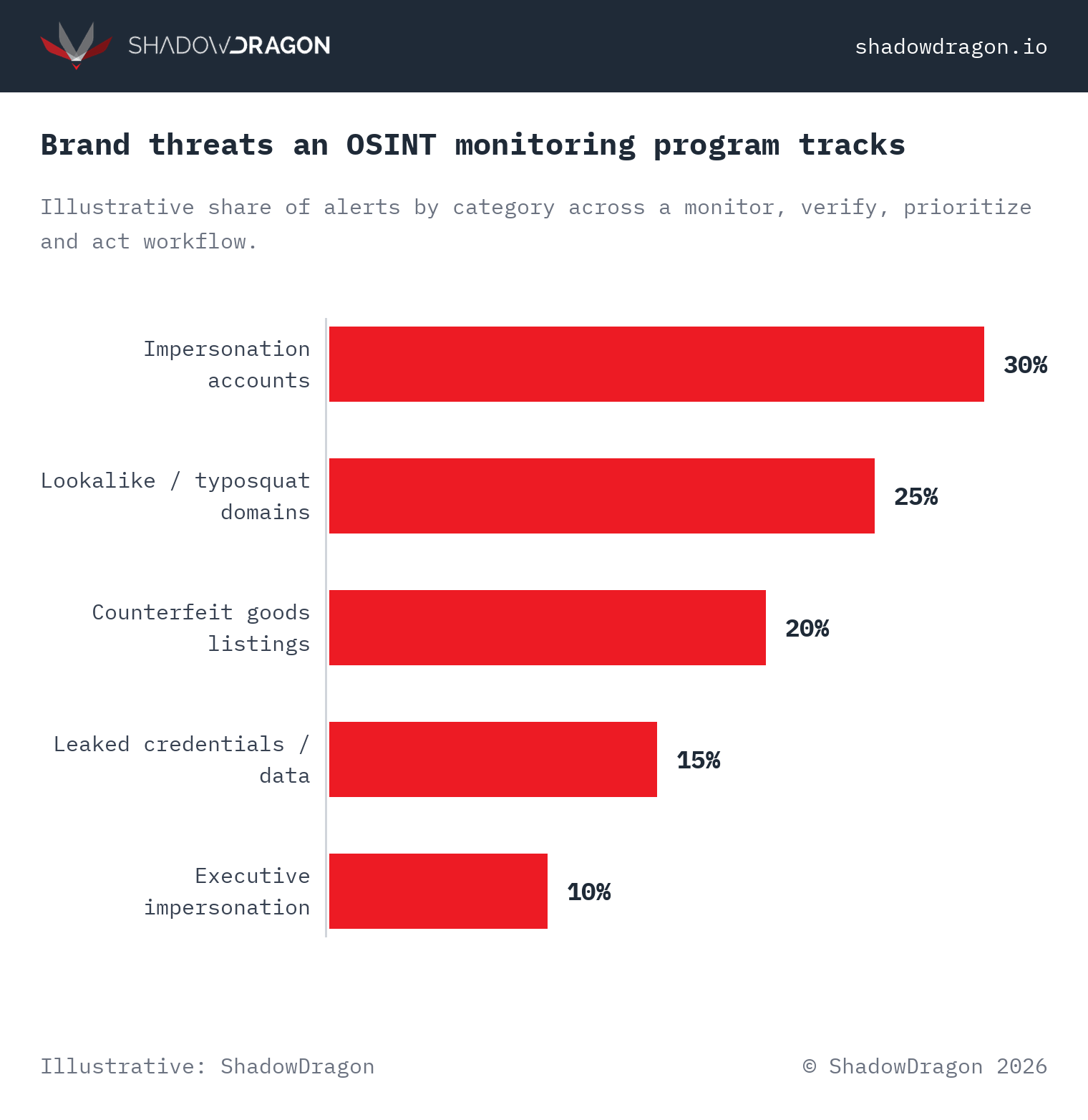
A brand protection monitoring workflow runs in four repeatable stages: monitor, verify, prioritize and act. Teams should treat it as a continuous loop rather than a one-time sweep, because new risks can appear daily.
The first stage is monitoring. Teams should begin by defining the assets they protect, including brand names, product lines, domains, logos, and named executives. Collection efforts should then be directed at the sources where abuse typically appears, with alerts configured to flag new matches. Broad coverage is essential at this stage, since attackers often operate on platforms teams are not monitoring. ShadowDragon®’s roundup of the best OSINT tools discusses the challenge of selecting the right tools from the hundreds available for this kind of coverage.
The second stage is verification. Not every alert is a threat. A fan account or a reseller can trigger the same keyword, and so can a news article. Analysts must confirm that a hit constitutes genuine abuse before it consumes response resources.
The third stage is prioritization. Analysts should rank confirmed threats according to potential harm, ensuring the most dangerous cases are addressed first. A phishing domain harvesting customer passwords, for example, warrants higher priority than a low-follower parody account.
The final stage is action. Teams route each prioritized case to the right response: a platform report, a domain takedown request, an internal alert or a law enforcement referral. Recording the outcome of each action allows the team to measure the effectiveness of its response strategy.
Verification and prioritization
Verification confirms that an alert reflects genuine abuse. Prioritization then ranks each confirmed case by its potential for harm, ensuring the team directs its effort where it matters most. Together, these two stages convert raw monitoring output into actionable decisions. Omitting these steps leaves responders overwhelmed by false positives.
To verify an alert, analysts pivot from the initial signal to supporting evidence, a process aided significantly by identity resolution. When an impersonation account and a lookalike domain share a registrant email or a reused image, they likely represent a single coordinated operation rather than unrelated incidents. A counterfeit listing tied to the same payment handle supports the same conclusion.
Investigators should prioritize confirmed threats using a straightforward risk model that accounts for reach, intent, and proximity to customers or funds. A spoofed executive account soliciting payments warrants a high-priority designation, while a dormant handle with no posting activity warrants a low one. Documenting these criteria ensures consistent decision-making across the analyst team.
Effective prioritization also safeguards a team’s credibility with external platforms. When an organization submits only verified, clearly harmful cases, takedown teams learn to trust its reports, which in turn accelerates response times.
When to escalate to takedown or law enforcement
Teams should escalate a takedown when a confirmed threat actively harms customers, and to law enforcement when the activity crosses into criminal fraud or coordinated theft. This threshold should be determined by the quality of evidence and the severity of the threat, not by how disruptive the abuse appears on the surface.
Most cases resolve through platform and registrar takedowns. The UK National Cyber Security Centre advises contacting hosting companies and domain registrars directly to request the removal of an impersonating service. Social networks and marketplaces offer abuse reporting channels that address impersonation, counterfeit sales, and phishing, and hosting providers maintain similar processes. An effective report includes the offending URL, proof of the organization’s rights, and a clear description of the harm caused.
Teams should reserve law enforcement referrals for serious cases, including large-scale financial fraud, extortion, credible threats to executives or organized counterfeiting rings. In the United States, the FBI Internet Crime Complaint Center accepts reports and aggregates them into the national picture reflected in its annual statistics. Investigators should preserve evidence carefully, since a clean record of what was observed and timeframes supports both civil and criminal action.
FBI leadership frames that reporting as the base layer of the national picture:
“The IC3, which is celebrating its 25th anniversary this year, is only as successful as the reports it receives; that’s why it’s imperative that the public immediately report suspected cyber-enabled criminal activity to the FBI.”
– Kash Patel, FBI Director, April 2025
A well-documented OSINT case file is what turns a single observation into a report the IC3 can aggregate and act on.
Legal counsel should stay in the loop for anything involving intellectual property enforcement or a subpoena. The OSINT work builds the evidence file that these formal steps rely on.
 Nico Dekens – aka “Dutch OSINT Guy”