Top 5 fraud detection techniques every organization should know in 2026

headshot of Nico Dekens – aka “Dutch OSINT Guy”Nico Dekens – aka “Dutch OSINT Guy”
17 Aug 2026
Key Takeaway

Fraud is constantly evolving, so organizations must use a combination of fraud detection techniques, tools, and intelligence (like ShadowDragon®’s Horizon® Identity, SocialNet®, and Monitor®) to stay ahead and respond faster.

Fraud detection techniques failed to stop $16 billion in reported consumer fraud losses in 2025, a record figure and a 25 percent increase over 2024, according to the Federal Trade Commission (2026). The most effective fraud detection techniques are identity verification with biometric authentication, rules-based systems, transaction monitoring with anomaly detection, machine learning models and network link analysis.

Layered together, these five methods detect account takeovers, synthetic identities and organized fraud rings that any single control misses.

This guide explains how each technique works, its benefits and limitations and the industries where it fits best.

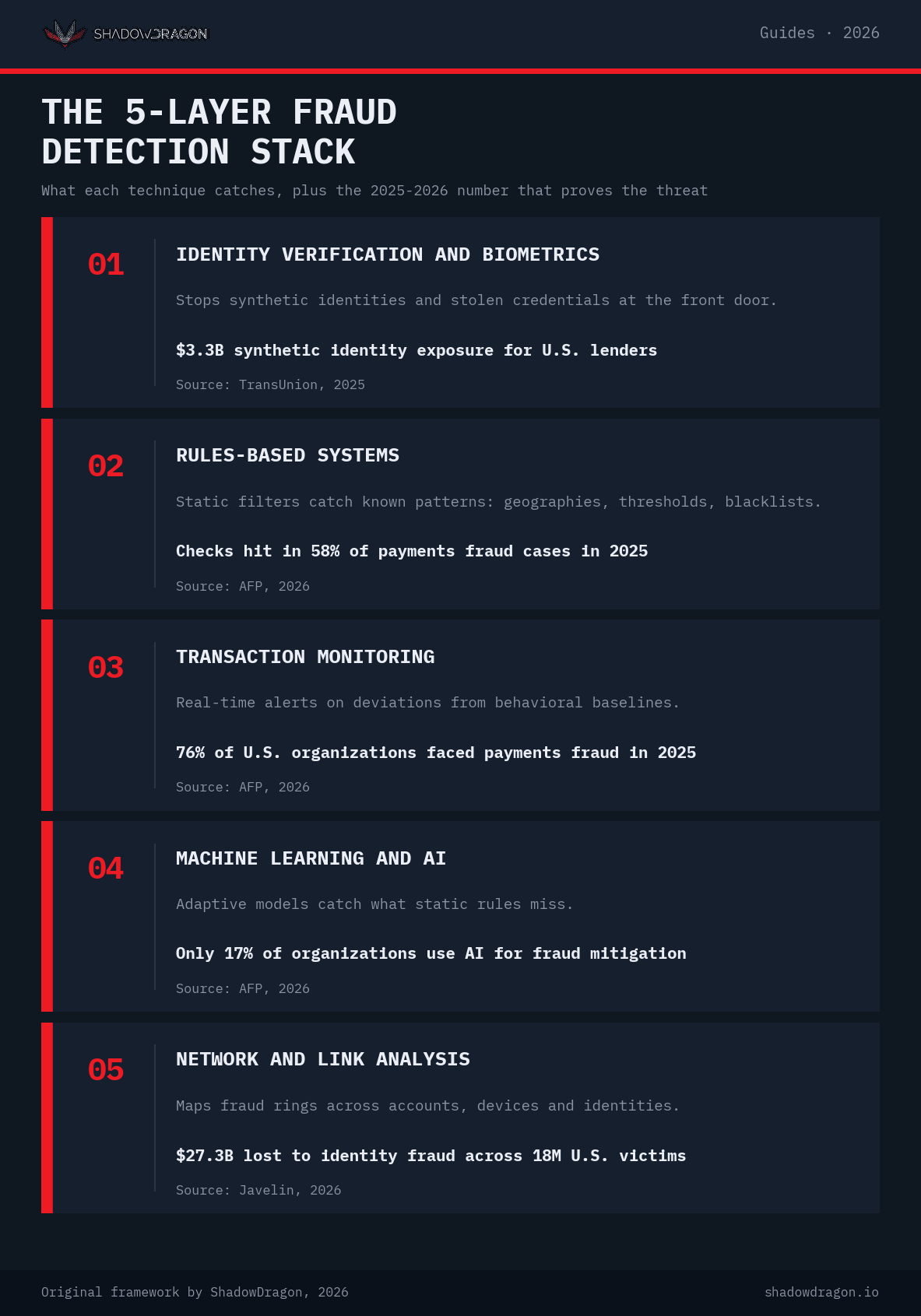
The 5-layer fraud detection technique stack: identity verification, rules-based systems, transaction monitoring, machine learning and network link analysis, each paired with a 2025-2026 fraud statistic.
The 5-layer fraud detection stack. Original framework by ShadowDragon, 2026. Sources: TransUnion (2025), AFP (2026), Javelin (2026).

Identity verification and biometric authentication

Effective fraud detection starts with verifying that an individual or organization is who they claim to be. Traditional approaches include document verification and Know Your Customer (KYC) processes. Uploading a driver’s license or passport, cross-checking it against government databases and verifying basic details are common steps. A structured KYC checklist keeps those verification steps consistent across onboarding.

Detecting synthetic identity fraud pushes verification further, combining device intelligence, behavioral biometrics and public-record checks to expose fabricated personas, which cost U.S. lenders an estimated $3.3 billion in exposure from newly opened accounts, according to TransUnion (2025).

TransUnion’s fraud lead points investigators toward public-record signals:

“While the presence of living characteristics such as vehicle ownership, voter registration or familial connections is not a definitive solution to detecting synthetic identities, it represents an important piece of the broader identity puzzle.”
– Steve Yin, Global Head of Fraud, TransUnion. TransUnion newsroom, September 2025

That is exactly the pivot OSINT-driven identity resolution automates: testing whether an identity has a real-world footprint.

Biometrics add another layer of assurance. Fingerprint and facial recognition handle login and transaction verification, while voice authentication spreads through contact centers. Multi-factor authentication blocks credential-stuffing attempts before account takeover succeeds.

Behavioral biometrics such as typing cadence and swipe patterns, plus device fingerprinting that checks hardware, browser and IP signals, flag account takeover attempts without adding friction for legitimate users.

Applications and use cases

  • Banking and Fintech: Customer onboarding, loan applications, remote account opening.
  • E-commerce: Reducing account takeover fraud during checkout.
  • Healthcare: Patient verification for telemedicine access.
  • Travel and Hospitality: Airport biometric gates for faster, more secure boarding.
  • Government: National ID programs and e-voting systems.

Benefits

  • High accuracy in verifying real identities.
  • Strong defense against account takeovers and synthetic identities.
  • Faster and easier logins with fingerprints or face scans.
  • Biometric traits are harder for fraudsters to fake.

Challenges and limitations

  • Privacy and data protection risks if biometric databases are compromised.
  • Potential bias in facial recognition technology.
  • High implementation and integration costs.
  • Users may resist adoption due to privacy concerns.

Rules-based systems

Pre-dating machine learning and other advanced techniques like biometrics, rules-based techniques have long been the traditional approach to fraud detection. Rules-based systems are still commonly used by organizations today, often as a first line of defense, because they’re simple transparent, and easy to implement.

Rules-based fraud detection applies rules in pre-defined conditions, and takes action based on these rules. For example, a purchase may be declined if it is over a pre-determined dollar amount. Other common rules-based methods include blacklisting known fraudulent accounts, IPs and devices, or using geolocation to determine whether a login or purchase is originating from an expected location.

Rules-based systems don’t learn. They’re static filters designed to detect obvious suspicious behavior.

Applications and use cases

  • E-commerce: Blocking transactions above certain dollar thresholds.
  • Travel Industry: Preventing booking fraud by blacklisting known stolen credit cards.
  • Banking: Denying transactions from sanctioned geographies.
  • Retail Loyalty Programs: Automatically flagging multiple accounts tied to the same IP address.
  • Corporate IT: Blocking logins outside of business hours.

Benefits

  • Transparent and easy to understand.
  • Quick to implement with minimal infrastructure.
  • Effective for catching well-known fraud patterns.
  • Useful as a baseline layer of defense.

Challenges and limitations

  • Static rules can’t adapt to new fraud tactics.
  • High maintenance burden to keep rules updated.
  • Generates many false positives in dynamic environments.
  • Limited effectiveness against sophisticated or evolving fraud.

Transaction monitoring and anomaly detection

Most fraud leaves a trail of breadcrumbs in the form of unusual activity. Transaction monitoring and anomaly detection observe activity in real time and raise alerts on transactions or patterns that don’t match expected behaviors.

The exposure is near-universal: 76 percent of U.S. organizations experienced attempted or actual payments fraud in 2025, according to the Association for Financial Professionals (2026).

Real-time monitoring systems track transactions as they unfold, giving organizations an opportunity to react before losses occur. They build behavioral baselines for each user or account, learning what typical behavior looks like.

Deviations from those baselines trigger alerts, based on risk scores and pre-defined thresholds. For example, these systems may flag activities such as wire transfers to a new country, unusual login locations, or transactions exceeding a certain dollar amount.

Applications and use cases

  • Payments: Flagging transactions outside normal spending patterns.
  • Cryptocurrency Exchanges: Spotting rapid, high-value transfers indicative of money laundering.
  • Telecom: Detecting SIM-swap fraud by monitoring unusual account activity.
  • Healthcare Billing: Identifying unusual claim submissions by providers.
  • Retail: Monitoring gift card transactions for fraud rings.

Benefits

  • Real-time detection and response reduces financial impact.
  • Builds behavioral baselines unique to each user or account.
  • Can be used across many industries, from finance to telecom.
  • Can integrate with case management for investigations.

Challenges and limitations

  • High false-positive rates if thresholds are too rigid.
  • May frustrate customers if legitimate transactions are blocked.
  • Fraudsters adapt quickly to common detection thresholds.
  • Requires constant fine-tuning to balance risk vs. customer experience.

Machine learning and artificial intelligence

AI and machine learning are highly effective in fraud detection because fraud rarely follows predictable patterns. Instead of relying on static rules, these systems learn from data, uncover hidden patterns, and adapt to new tactics.

Supervised learning trains models on labeled examples of fraud and legitimate activity to spot similar patterns. Unsupervised learning identifies anomalies and outliers that may indicate emerging fraud schemes without the need for labeling. Advanced techniques like neural networks, deep learning, and natural language processing (NLP) analyze large datasets, detect subtle relationships, and flag suspicious activities.

Adoption still trails the threat: only 17 percent of organizations currently use AI for fraud mitigation, per the same AFP survey, while 90 percent of financial crime professionals report increased AI-driven attacks, according to Nasdaq Verafin (2026).

Together, these techniques provide organizations with broad capabilities to detect fraud from multiple angles. However, it’s important to recognize the challenges and limitations of AI, such as bias in training data, difficulty handling ambiguous or novel scenarios, and a lack of contextual understanding beyond patterns.

AI also cannot make ethical or moral judgments, raising concerns in sensitive applications. Additionally, AI systems often produce false positives or negatives, require large amounts of high-quality data, and struggle with transparency and explainability. These tools should be used to augment the work of human analysts, not replace them. Combining AI’s speed and scale with human judgment and intuition ensures more accurate and ethical outcomes.

Applications and use cases

  • Credit Card Fraud: Real-time flagging of unusual purchase behaviors.
  • Insurance: Detecting staged accidents or fraudulent medical claims.
  • Cybersecurity: Identifying phishing emails and malicious login attempts.
  • Retail and E-commerce: Detecting fake reviews or fraudulent loyalty program activity.
  • Banking: Predictive risk scoring for loan approvals.

Benefits

  • Detects complex, evolving fraud patterns that humans and static rules miss.
  • Adapts continuously with new data (self-learning).
  • Scales easily across millions of transactions.
  • Reduces false negatives by identifying previously unseen fraud schemes.

Challenges and limitations

  • High-quality, labeled data is needed for accuracy.
  • Models can be “black boxes,” making explainability difficult.
  • Fraudsters may attempt to game or poison AI models.
  • Implementation requires significant resources and expertise.
  • Human investigators provide critical context, ethical judgment, and adaptive problem-solving that AI cannot replicate.

Network and link analysis

Organized fraud groups use multiple accounts, devices and identities to obfuscate their actions, making it difficult to detect patterns when looking at transactions or behavior in isolation. Network and link analysis fills this gap by mapping the connections between individuals, accounts and activity, revealing associations between seemingly disparate data points that would otherwise remain undetected.

Investigators use graph analysis to visualize how money, data or logins flow through a network and social network analysis to expose clusters of coordinated activity that may point to collusion. Link analysis then connects identifiers such as email addresses, phone numbers, IP addresses and social media profiles into a single intelligence picture.

In anti-money laundering (AML) casework, these graph analytics surface mule account networks and layered transactions that transaction-level scoring cannot see. For the chart-building methodology, see the guide to using link analysis in investigations.

How investigators detect collusion rings and account linking fraud

Collusion rings and account linking fraud surface when platforms connect identifiers that fraudsters try to keep separate. Investigators detect collusion rings by linking accounts that share devices, IP addresses, payment instruments, phone numbers or shipping addresses, then scoring those clusters for coordinated behavior such as synchronized logins, circular refunds or review manipulation.

Device fingerprinting ties multiple personas back to one machine even when names and emails differ. Graph analysis then exposes the ring structure: a handful of hub accounts connected to dozens of disposable ones.

New-account fraud, a staple of ring activity, jumped 31 percent in 2025 to 5.4 million U.S. victims, according to Javelin Strategy and Research (2026).

The scale of coordinated fraud is why graph-based methods now anchor serious programs:

“We are currently in the midst of a full-blown financial crime crisis, powered by criminal networks that are leveraging AI to super-charge scam playbooks and operating with the scale and coordination of multinational corporations.”
– Stephanie Champion, Executive Vice President and Head of Nasdaq Verafin. Nasdaq press release, March 2026

Networks organized like corporations leave corporate-scale link trails. That is the surface network analysis attacks.

ShadowDragon’s suite of open-source intelligence (OSINT) tools gives fraud investigators graph analytics, link analysis and case-ready reporting inside one platform. Horizon® Identity resolves disparate identifiers into real-world identity profiles for rapid triage. SocialNet® extracts connections from hundreds of online sources to reveal social and digital associations, feeding link analysis charts that map fraud rings for AML case management. Horizon Monitor® continuously watches those networks and alerts investigators when new activity appears, supporting anti-money laundering investigations, cybercrime casework and threat intelligence operations end to end.

Together, these tools give investigators the ability to build a complete intelligence picture starting from a single data point, uncovering hidden relationships, tracking evolving threat actor activity, and connecting online behaviors to real-world entities. This end-to-end visibility not only shortens investigation timelines but also strengthens attribution, enabling teams to make faster, more confident decisions in fraud detection, cybercrime investigations, and threat intelligence operations all within one platform.

Applications and use cases

  • Financial Services: AML (anti-money laundering) investigations uncovering layered transactions.
  • Insurance: Detecting fraud rings staging multiple fake accidents.
  • E-commerce: Linking synthetic identities across multiple fake accounts.
  • Telecom: Tracing collusion between insiders and external fraudsters.
  • Law Enforcement: Mapping criminal organizations using digital footprints.

Benefits

  • Reveals large-scale, organized fraud schemes.
  • Provides visual insights for investigators and compliance teams.
  • Helps connect seemingly unrelated data points.
  • Strengthens AML and regulatory compliance.

Challenges and limitations

  • Requires advanced computing power for large datasets.
  • Visualization can be complex with massive networks.
  • Risk of false associations if data quality is poor.

Fraud detection techniques in banking

Fraud detection techniques in banks layer five methods: real-time transaction monitoring, rules-based screening, machine learning fraud scoring, identity verification and network link analysis. Banking fraud detection systems monitor card, wire and ACH payments against behavioral baselines, apply rules that block transactions from sanctioned geographies and flag anomalies with machine learning models trained on labeled fraud.

Banks face heavy pressure on legacy payment methods: 58 percent of organizations hit by payments fraud in 2025 were targeted through checks, while 76 percent of U.S. organizations experienced attempted or actual payments fraud, according to the Association for Financial Professionals (2026). Link analysis completes the banking fraud stack, connecting mule accounts and synthetic identities that per-transaction scores miss.

The case for a layered approach to fraud detection

There’s no silver bullet when it comes to fraud prevention. Rules-based algorithms are relatively quick and easy to set up but fail to evolve with criminals. Machine learning is good at detecting complex patterns but requires clean data and some human oversight.

Biometrics provide additional assurance, but they carry privacy concerns. Transaction monitoring works in real time but can generate noise if thresholds aren’t carefully fine-tuned. Network and link analysis tools reveal hidden connections, but visualization can be complex when mapping extensive fraud networks.

A layered approach brings together the strengths of these different methods. Identity verification keeps fraudsters from accessing your ecosystem in the first place. Rules-based models and transaction monitoring can be a simple first line of defense.

Machine learning and anomaly detection identify what gets through those initial filters. Network and link analysis can tie together disparate alerts and uncover the bigger schemes behind them.

Teams that pair these five layers with dedicated fraud detection software tools close the remaining gaps faster. Investigators who add proven OSINT techniques to that stack move from a single alert to full attribution without changing platforms.

No one method is foolproof against account takeovers, synthetic identities, or organized fraud rings on their own, but each can form part of a more holistic defense.

Falling loss numbers are not a reason to relax any layer:

“Reduced losses do not mean reduced risk. A 45% drop may look like progress, but scammers are increasingly stealing information instead of money, setting up future fraud that doesn’t show up in today’s loss figures.”
Suzanne Sando, Lead Analyst, Fraud Management, Javelin Strategy and Research. Javelin press release, April 2026

Stolen data that has not been monetized yet is exactly what continuous network monitoring is built to catch.

With Horizon® Identity, SocialNet®, and Horizon Monitor®, investigators can move quickly from a single suspicious data point to a mapped-out fraud network.

These tools shorten investigation timelines, strengthen attribution, and provide the clarity needed to act with confidence. Contact us for a demo today to learn how ShadowDragon® can strengthen your fraud detection capabilities.

Frequently asked questions

What is the most common method of detecting fraud?

The most common method is transaction monitoring combined with rules-based systems. Organizations flag suspicious activity based on predefined thresholds (e.g., unusually large transactions, logins from new locations) to quickly catch anomalies.

What is the most effective fraud detection technique?

A layered approach is most effective. Combining machine learning, behavioral analytics, biometrics, and network analysis provides stronger protection than relying on any single method.

Aren't rules-based systems outdated compared to AI and machine learning?

Not at all. While rules-based systems are one of the older techniques, they’re far from obsolete. They provide a critical, transparent, and easy-to-implement first line of defense for catching known, obvious fraud patterns (e.g., blocking transactions from high-risk countries). They’re often used to handle simple checks efficiently, freeing up more advanced AI models to focus on complex, evolving threats. The key is to use them in conjunction with, not instead of, adaptive technologies.

What are red flags in fraud detection?

Red flags include sudden changes in behavior, unusual transaction amounts, mismatched or inconsistent identity data, multiple accounts linked to the same device, and attempts to bypass authentication.

What is the 10-80-10 rule in fraud?

The 10-80-10 rule is a rule of thumb in fraud examination. It holds that 10 percent of people never commit fraud and 10 percent actively look for ways to commit it. The remaining 80 percent might commit fraud when pressure, opportunity and rationalization line up.

Fraud controls exist chiefly to keep that 80 percent honest by removing opportunity and raising the odds of detection.

What are the most common types of fraud?

Common groupings cover identity theft, payment and credit card fraud, check and ACH fraud, account takeover, synthetic identity fraud, occupational or insider fraud and imposter scams.

Imposter scams alone drove $3.5 billion in reported U.S. losses in 2025, according to the Federal Trade Commission (2026).