Best KYC software platforms and digital tools for banks (2026 guide)

headshot of Nico DekensNico Dekens
30 Mar 2026
Digital fingerprint authentication with biometric identity verification and data network overlay
Key Takeaway

  • KYC software platforms help banks verify identities, assess risk, and stay compliant by combining data from multiple sources and automating onboarding and monitoring processes.
  • The most effective KYC strategies combine traditional verification with deeper data enrichment (like OSINT) and continuous monitoring to catch hidden risks, reduce fraud, and improve decision-making over time.

Banks are facing increasingly stringent compliance requirements. At the same time, they’re facing rising fraud, expanded risk vectors and newer threats tied to crypto activity, alongside customer expectations for frictionless onboarding. These combined pressures first appear in the Know Your Customer (KYC) onboarding process. If your tools fall short, risk can slip into your system, or good customers may walk away.

We’ve identified the best KYC software platforms and digital tools for banks for various use cases, including:

This guide breaks down how KYC tools work. We’ll walk you through the features that matter when you’re running a robust KYC compliance program. Then, we’ll compare 31 KYC platforms and digital tools for banks so you can choose the right platforms for your bank’s needs.

To create this guide, we evaluated leading KYC software and identity tools across several key areas. We looked at how well each platform verifies individuals and businesses and how they handle high-volume onboarding and support risk-based decisions.

We considered the depth of each tool’s data sources and the quality of its sanctions and adverse media coverage. We took into account how cleanly it ties identity signals together. In addition to AML workflows, we also factored in each platform’s integration with core banking systems and case management capabilities.

From open-source intelligence (OSINT) driven visibility in ShadowDragon® Horizon® to full client lifecycle systems and modular verification tools, every option in this article solves critical parts of the KYC puzzle. The right choice depends on your bank’s unique onboarding flow and how your team handles identity and due diligence work from day to day.


What are KYC software platforms?

KYC software platforms help banks understand who they’re dealing with before accounts are opened and funds are moved. These tools pull data from various sources to give teams a clear picture of a person or business. They check identity signals and identify gaps and inconsistencies, enabling banks to identify risks early in the process.

Banks use KYC software platforms during onboarding and ongoing monitoring. The goal is to reduce risk exposure and identify problems before they spread through the system. A robust KYC software platform supports the steps in a KYC checklist and has numerous capabilities, such as:

  • Identity verification
  • Document checks
  • Sanctions screening
  • Watchlist checks
  • Transaction patterns

KYC platforms reduce manual steps that often slow down due diligence, helping compliance teams work faster without weakening risk controls and oversight. Most KYC platforms integrate with internal systems and external data sources. These tools support compliance regulations and standards related to preventing financial crime and money laundering, such as:

KYC software does not replace human judgment. It gives analysts better visibility and surfaces context that would take hours to find manually. It helps banks make better decisions with less friction.

What to look for in KYC software platforms and digital tools for banks

Banks face constant pressure to verify customers quickly and accurately. The right KYC tools make this possible.

These tools bring identity signals and risk indicators into a central solution, helping analysts focus on more complex tasks and decision-making instead of chasing missing data. When reviewing KYC software platforms and digital tools for banks, these are the features that matter most.

  • Automated identity verification and document verification. The system should be able to read IDs and match photos. It should also be able to confirm the authenticity of documents. This reduces manual checks and helps teams work more efficiently.
  • Biometric verification and digital identity checks. Face matching and liveness checks help confirm a real person is present and not hiding behind synthetic data.
  • Entity and beneficial owner verification for businesses. Banks need a clear understanding of who owns a company. The best KYC and Know Your Business (KYB) tools map corporate structures and reveal control layers. This helps banks identify Ultimate Beneficial Owners (UBOs).
  • Customer Due Diligence (CDD) A KYC platform should guide teams through standard checks, such as identity and risk signals. These processes should follow simple paths.
  • Enhanced Due Diligence (EDD) support. High-risk customers require a closer review. The best KYC tools help teams gather additional data and maintain documentation that explains why decisions were made.
  • Sanctions, watchlist, and PEP screening. Banks rely on deep screening against trusted lists. Matches should be clear, and false positives should be low. PEPs are politically exposed persons, or those with high-profile, public-facing roles that put them at increased risk of bribery or corruption.
  • Adverse media checks. Robust KYC platforms scan news and open data for negative news coverage. These signals help teams recognize early risk patterns.
  • Ongoing transaction monitoring. Behavior shifts over time. Tools should monitor transactions for unusual activity and surface patterns that may point to fraud or money laundering.
  • Risk scoring. A solid scoring model consolidates key signals into a single view. This helps teams decide when to escalate or approve a customer.
  • Case management and alert management workflows. Analysts need an organized workspace. Alerts should route to the correct person, and cases should maintain all evidence in one central repository.
  • Integration with external data sources and watchlists. Banks depend on broad data. A good KYC tool integrates smoothly with third-party sources and keeps information up to date.
  • Automated workflows. Routine tasks should run automatically. This removes repetitive steps, so analysts can focus on more complex tasks and decision-making.
  • Support for periodic or event-triggered re-screening and remediation. Customers change. KYC tools should trigger new checks when risks shift or when the rules require KYC remediation.
  • Audit trails and logging. Every action should be recorded. This helps banks explain decisions during audits and internal reviews.
  • Reporting capabilities. Teams need quick access to summaries. They need to be able to easily recognize trends and bottlenecks. These reports drive better decision-making.
  • Configurable workflows and custom rule definitions. No two banks operate the same way. Strong KYC tools adjust to internal policies and processes without significant development work.
  • Flexible KYC integration with core banking and onboarding systems. Connections to existing systems and fraud detection tools should be simple to set up and reliable. Data should move between systems without friction.
  • Role-based access controls (RBAC). Teams need tight control over who sees what to protect sensitive data. RBAC also aligns with various regulatory compliance requirements.
  • Flexibility to meet global and local regulatory requirements. Rules differ by region. A good KYC platform adapts to those changes and keeps banks aligned without significant rework.

As customer volumes grow, manual review becomes unmanageable. These features enable banks to onboard customers efficiently while still conducting appropriate checks. This reduces friction for customers without compromising compliance.

KYC software platforms that have these features and capabilities support ongoing monitoring and risk management beyond initial onboarding. This is essential for detecting money laundering and other fraudulent activities over time.

These features also support auditability and regulatory defensibility with logs and traceability. This documentation is critical for compliance audits and investigations.

KYC software platforms and digital tools for banks comparison (Top 10)

Before we get into the full list, here’s a quick comparison chart that shows the best use cases, deployment and integration options, and key features for 10 of the best KYC software platforms.

KYC Platform Best For / Use Case Deployment Options / Integration Methods Key Features
ShadowDragon® Horizon® OSINT-Based Identity Enrichment and Uncovering Hidden Connections – Browser-based platform
– Export-ready reporting
– No-code search interface
– Builds identity profiles across 550+ public sources, 1,500+ endpoints, and 15B+ breach records.
– Link analysis reveals aliases, beneficial ownership, hidden associations.
– Horizon Monitor® tracks identifiers across social media, forums, and dark web sources.
LexisNexis Risk Solutions High-Assurance Identity Verification Using Authoritative and Proprietary Data Sources – API
– Batch processing
– Web portal
– Billions of public + proprietary records for KYC/KYB screening.
– Alternative data signals help verify thin-file identities.
– Risk scoring, case management, and audit trails for regulated banks.
Moody’s KYC and Compliance Solutions Unified Entity Risk Intelligence and Complex Corporate Due Diligence – API integrations
– Configurable workflow engine
– Platform dashboard
– Consolidated entity and risk profiles across global datasets.
– Ownership mapping for multilayer corporate structures.
– Customizable rules-based workflows for onboarding and ongoing monitoring.
Sumsub Fast Global ID Verification with Strong Fraud Defenses and Reusable Identity – Web SDK
– Mobile SDK
– REST API
– QR/link verification flows
– 14,000+ ID document types across 200+ countries.
– Automated document + biometric verification in under 30 seconds.
– Reusable identity, AML screening, and transaction monitoring.
GBG Nuanced Identity Assessment with Location and Device Intelligence – API
– SDKs
– No-code/low-code integration options
– Global identity, address, mobile, and location verification.
– Device and behavioral intelligence to detect risky activity.
– Identity-score model provides nuanced risk classifications beyond pass/fail.
Fenergo Enterprise-Scale Client Lifecycle Management and KYC Orchestration – Cloud-native platform
– API-based workflows
– Configurable rule engine
– Full CLM suite covering onboarding, KYC, due diligence, and monitoring.
– Pre-built compliance rulesets for 120+ jurisdictions.
– Corporate structure mapping and UBO identification.
ComplyAdvantage AI-Driven AML Screening and Adverse Media Intelligence – API
– Case management dashboard
– Workflow integrations
– Global sanctions, PEP, watchlist, and adverse media screening.
– Dynamic risk scoring with customizable rules.
– Continuous monitoring with automated alerts and case workflows.
KYC Hub No-Code KYC Workflows and Perpetual Monitoring – API
– No-code workflow builder
– Modular platform
– 100,000+ global data sources for KYC/KYB/AML.
– Perpetual KYC and transaction monitoring capabilities.
– Customizable no-code workflows, questionnaires, and conditional logic.
Socure Inclusive Digital Identity Verification with High Auto-Approval Rates – API
– Low-code/no-code workflow orchestration
– Verifies hard-to-verify populations using alternative data and ML models.
– Device, email, phone, and IP intelligence for fraud scoring.
– Continuous monitoring for identity and fraud-risk changes.
AU10TIX High-Speed Biometric Document Verification at Global Scale – API
– SDKs
– Mobile integration
– Supports thousands of document types across 200+ jurisdictions.
– AI-based biometric matching and liveness detection.
– Deep forgery/tamper detection for synthetic and stolen ID prevention.


Let’s explore these and other leading KYC software platforms and digital tools for banks in detail.

ShadowDragon® Horizon®: Best for OSINT-Based identity enrichment and uncovering hidden connections


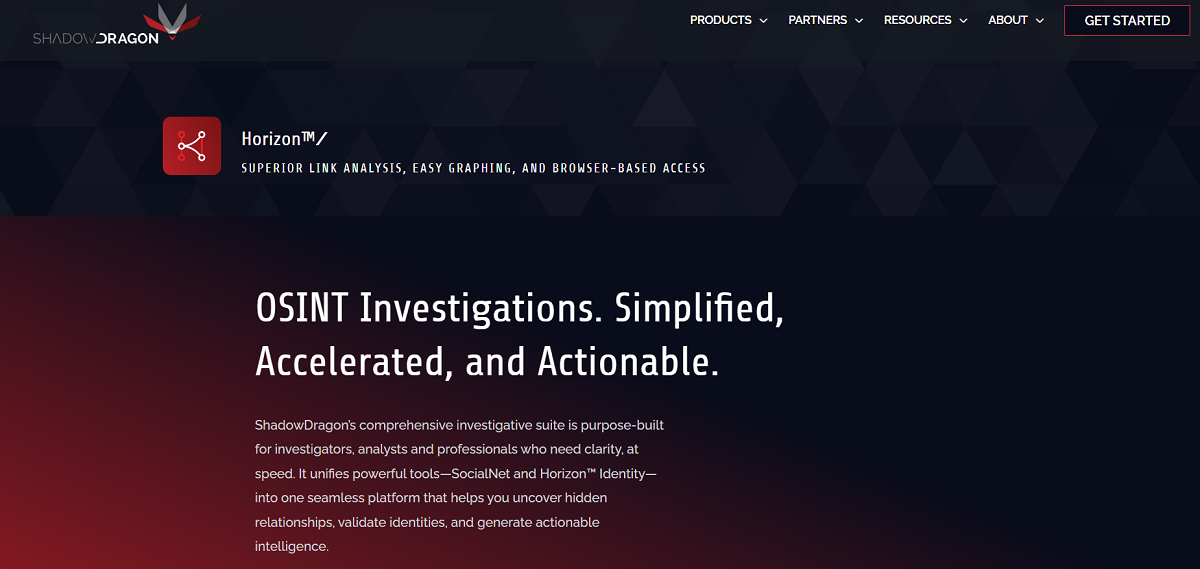
ShadowDragon® Horizon® is not a traditional KYC software platform. It’s a browser-based OSINT and link-analysis platform that compliments KYC software solutions.

The platform comprises ShadowDragon® Horizon®, Horizon® Identity, and Horizon Monitor®. With Horizon® Identity, banks can start with a single identifier, such as an email or username, to confirm that the identity presented in the customer-supplied documents is real. It leverages more than 550 publicly available sources and more than 1,500 endpoints, as well as more than 15 billion breach records.

Horizon® Identity helps to identify inconsistencies between the information the customer provided and real-world activities, revealing associated accounts or usernames. It can also reveal potential indicators of a synthetic identity. For example, when there’s little or no digital activity associated with a customer, it’s a red flag.

Each newly discovered data point can be used to expand the search. This enables users to build a more complete profile with just a few clicks.

ShadowDragon® Horizon® offers link analysis and graphing capabilities. This helps surface relationships such as beneficial ownership and undisclosed connections to sanctioned individuals or high-risk entities.

In addition, Horizon® can help identify multiple aliases or online identities associated with the same applicant. This is especially valuable for onboarding high-risk customers or businesses with complex ownership structures.

Horizon Monitor® enhances perpetual KYC by monitoring customers’ identifiers across publicly available sources, such as social media and the dark web. It can alert compliance teams when risky activity is detected, such as adverse media mentions or new associations with known criminal networks.

Incorporating ShadowDragon® Horizon®, Horizon® Identity, and Horizon Monitor® into the KYC onboarding process gives banks visibility beyond self-reported data and database checks, supporting every stage of KYC verification.

ShadowDragon®’s OSINT tools can help banks confirm a customer’s identity and verify that it’s linked to a real person. They can help detect reused or stolen credentials and undisclosed connections to high-risk individuals or entities. In addition, Horizon Monitor® supports ongoing monitoring to continuously track publicly available information sources and alert compliance teams of potential threats or relevant activities.

Key Features:

  • Instantly build a comprehensive identity profile starting from a single identifier
  • Searches across 550+ public sources, 1,500+ endpoints, and 15+ billion breach records
  • Easily expands searches as new data points are uncovered
  • Advanced search and link analysis capabilities
  • Surfaces associated aliases and activity while minimizing false positives
  • Real-time monitoring and alerts
  • Simple, search-bar interface designed for non-technical users
  • Generates export-ready profiles and timelines to support fraud investigations and compliance reporting

LexisNexis Risk Solutions: Best for high-assurance identity verification using authoritative and proprietary data sources


LexisNexis Risk Solutions’ KYC and due diligence platform combines data analysis and identity verification tools, drawing on billions of public and proprietary records to support strong KYC programs for banks. It offers tools for customer identity verification as well as corporate-level due diligence and risk screening for KYB.

After onboarding is complete, the system continues to monitor customers. It issues alerts when data changes, allowing compliance teams to investigate. It’s a scalable solution that supports API, batch, and portal-based workflows for banks handling large customer volumes.

Key Features:

  • Large global dataset built from public and proprietary records
  • Strong identity verification for individuals through InstantID
  • Coverage for thin-file or no-credit customers using alternative identity signals
  • Case management and audit trails that support compliance reviews
  • Analytics and risk-scoring models that help reduce false positives and speed decision-making

Moody’s KYC and compliance solutions: Best for unified entity risk intelligence and complex corporate due diligence


Moody’s offers end-to-end KYC and AML tools for onboarding and compliance for both individual customers and businesses, including suppliers and third parties. It unifies entity and risk data, providing a single, integrated compliance view that eliminates the need to juggle multiple data sources or tools.

Moody’s offers global coverage, including entity data that spans hundreds of millions of companies across many jurisdictions. With configurable compliance workflows that integrate with Moody’s broader product offerings, Moody’s is a flexible, scalable platform that can support banks with high-volume onboarding or complex corporate client bases.

Key Features:

  • Banks can build their own compliance rules and define workflows with customizable risk parameters
  • Combines structured company and ownership data with curated risk intelligence to reduce false positives
  • Consolidated entity and risk profiles eliminate the need to manage multiple tools and data sources
  • Global data coverage, including risk and compliance data such as sanctions and adverse media
  • Tracks and maps ownership paths and beneficial owner relationships for business clients with layered ownership or complex control hierarchies

Sumsub: Best for fast global ID verification with strong fraud defenses and reusable identity


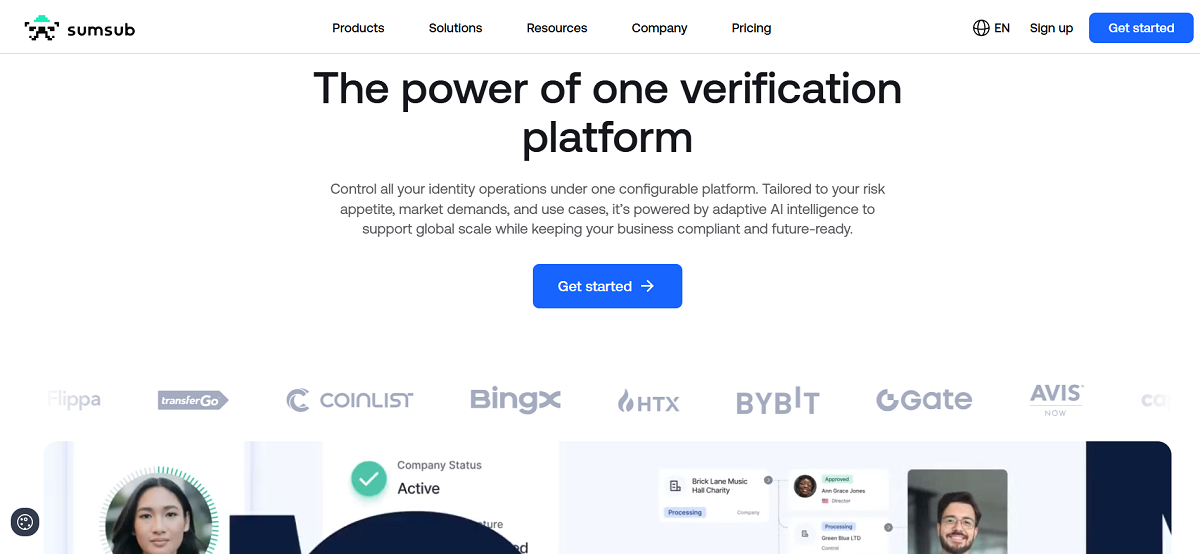
Sumsub is a unified identity verification and compliance platform. It offers document and biometric checks. It also provides fraud scoring and adaptable risk controls. The platform supports both individual verification and business-entity verification (KYB), as well as AML screening. Using OCR and automated checks, it can detect tampering or forgery and validate authenticity.

Sumsub offers fraud detection and transaction monitoring. It also provides identity-reusability features. The platform supports more than 14,000 identification document types from more than 200 countries and territories, across many languages. Sumsub claims that many verifications are completed in under 30 seconds, or as little as 20 seconds for simple identity checks. This helps to smooth onboarding processes and reduce drop-offs.

Key Features:

  • Supports non-doc verification and alternative verification paths in some jurisdictions
  • Reusable Identity available with Sumsub ID to reduce repeated onboarding friction
  • Flexible integration via SDK or REST API, or a simple link/QR option to easily embed Sumsub into apps or platforms
  • Modular, customizable KYC and KYB workflows with tailored processes by country or user type
  • Supports ongoing monitoring throughout the user lifecycle

GBG: Best for nuanced identity assessment with location and device intelligence


GBG is an identity and location intelligence platform that combines data verification with fraud detection tools and global risk-screening databases. It helps banks and other institutions screen for risk and manage KYC and AML compliance.

The platform offers APIs and SDKs to integrate identity verification into a bank’s signup or onboarding flows. No-code and low-code workflows are also available.

GBG’s unique identity score concept goes beyond traditional pass/fail KYC processes. It’s especially helpful in markets where traditional data is thin or unreliable. Instead of declining people who don’t pass a strictly binary KYC check, GBG’s scoring model provides a more nuanced view, allowing teams to balance risk and conversion without compromising security.

Key Features:

  • Global identity verification and data-based verification support cross-border onboarding and verification
  • Device intelligence and behavior signals to identify risky behavior early
  • Identity score model that helps teams assess risk instead of relying on pass-fail checks
  • Ongoing monitoring for changes in customer risk or suspicious activity
  • Scalable infrastructure suitable for high-volume and multi-country onboarding

Other KYC software platforms and digital tools for banks to consider

Not all banks require the same KYC stack. Outside of the leading platforms discussed above, there are dozens of solutions that specialize in niche areas, ranging from biometric identity verification to reusable identity and transaction monitoring.

Below are some tools to consider as you look for solutions that align with your organization’s needs and workflow.

AU10TIX

AU10TIX is an AI-powered identity verification and fraud defense platform. The company started as an identity intelligence solution for border control and airports. It has evolved into a full digital identity and KYC and AML compliance platform that enables banks and other institutions to securely and quickly verify individual customers and businesses worldwide.

AU10TIX uses biometric and AI-driven verification instead of manual document review to fight identity fraud and reduce friction in account creation without compromising compliance. With AU10TIX, identity checks are typically completed in seconds, reducing onboarding time compared to manual processes.

Key Features:

  • Global document and jurisdiction coverage, including thousands of document types from more than 200 jurisdictions worldwide
  • Supports digital IDs and NFC-enabled identity documents with deep document forgery and tamper detection
  • Flexible onboarding flows with API and SDK integration
  • Fraud prevention signals that detect synthetic identities and spoofing
  • Scalable infrastructure for high-volume, cross-border onboarding

CLEAR

CLEAR started as a biometric identity-verification service used in airports and physical-security settings. Recently, the company has expanded into identity and compliance services for financial services. The company’s identity verification offering, CLEAR1, allows users to complete a one-time verification (an identification document and a selfie) and then use that verified identity across services that support CLEAR.

CLEAR’s reusable identity reduces friction during onboarding and speeds subsequent verifications, giving banks a fast, user-friendly way to verify customers while maintaining compliance and reducing fraud risk.

Key Features:

  • Single ID plus selfie verification can be used across services
  • Offers biometric verification, including selfie and ID matching, plus anti-fraud and liveness checks for stronger assurance
  • Provides secure authentication for account recovery and sensitive transactions
  • Real-time verification and risk-signal checking support fast onboarding and urgent workflows
  • Flexible integration allows banks to embed CLEAR1 into onboarding, re-verification, account recovery, and transaction authorization flows

ComplyAdvantage

ComplyAdvantage Mesh is an AI-driven, SaaS-based risk intelligence platform that aggregates data from a variety of global data sources. It provides automated screening against watchlists and checks for adverse media. The platform then applies risk-scoring logic based on customizable thresholds. Additionally, ComplyAdvantage offers continuous monitoring to alert banks of changes to risk indicators, such as negative news mentions or updated sanctions lists.

Key Features:

  • Automated KYC screening at onboarding with configurable risk rules
  • Continuous monitoring that alerts teams when customer risk changes
  • Transaction risk insights help teams identify suspicious behavior earlier
  • Case management tools that keep reviews organized and auditable
  • API integrations to plug screening and monitoring into existing workflows

Didit

Didit is an AI-powered identity verification and KYC platform for banks and other online services  to verify user identity and reduce fraud. It combines document checks and real-time fraud detection with facial biometrics and modular AML tools, enabling flexible workflows on a unified platform that scales from small banks to larger firms.

Didit operates on a “free core KYC” model, meaning that basic identity verification is free. Paid add-on modules support more advanced compliance or verification needs. Banks can use a full API-based workflow or embed Didit via SDK or iFrame. It’s also possible to launch simple no-code verification flows via simple links.

Key Features:

  • Fast verification for smooth onboarding, including biometrics and liveness checks, plus document verification
  • Supports IDs from many countries globally
  • Banks can enable optional modules, including proof-of-address verification, sanctions and watchlist screening, age estimation, email or phone verification, and behavioral analytics for real-time fraud detection
  • Free, unlimited core KYC verifications with a prepaid-credit-based modular architecture for premium features
  • Flexible integration options, including full API-based workflows, embedding via SDK or iFrame, or simple no-code verification flows via links

EXL Digital KYC

EXL Digital KYC works well for banks and financial institutions that need to handle large onboarding volumes or want to reduce their manual compliance workload. It offers reliable coverage across jurisdictions, and its scalability and automation make it suitable for banks with complex compliance requirements.

It also helps banks maintain compliance over the client lifecycle with ongoing client monitoring and screening. EXL Digital KYC can be deployed as standalone software or as KYC-as-a-Service.

Key Features:

  • Aggregates data from internal and external sources, including more than 30 data feeds covering over 20 countries
  • Reconciles data before ingestion, checking for duplicates and quality
  • Supports perpetual KYC with continuous monitoring and automatic alerts when a customer’s risk profile changes
  • Can be delivered on-site or via cloud, with non-intrusive integrations into existing systems
  • Provides KYC-as-a-Service for banks that want to outsource KYC processes

Fenergo

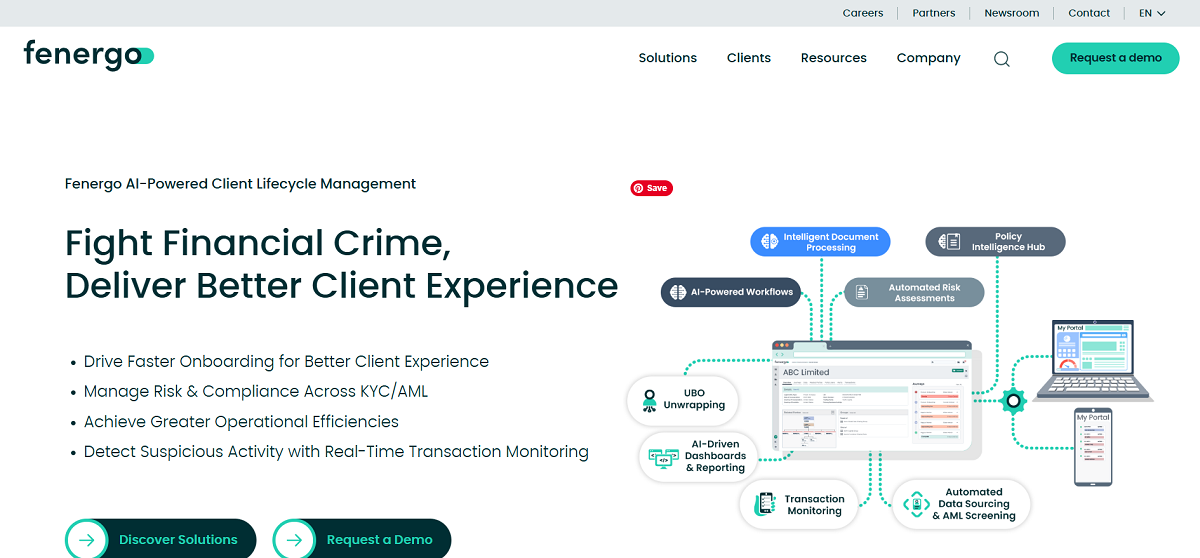
Fenergo is a cloud-native client lifecycle management (CLM) and compliance software platform built for banks and financial institutions. It combines numerous capabilities into a single platform, from KYC onboarding to continuous risk monitoring and transaction compliance.

Fenergo aims to simplify and standardize how banks manage clients from first contact through account opening and ongoing compliance across many jurisdictions and client types. Its automation and workflow orchestration help reduce manual tasks and compliance overhead. The platform supports risk-based KYC with pre-built rulesets across more than 120 jurisdictions covering individuals and entities.

Key Features:

  • Automatic identity verification and data collection through API integrations with external data and screening providers
  • Modular, cloud-native SaaS architecture that scales with institution size
  • Supports flexible deployment via APIs and configurable workflows
  • Built-in tools to map and manage complex corporate structures to identify UBOs and relationships
  • Policy-management engine that enforces global and local regulatory compliance, including AML, across jurisdictions

FOCAL

FOCAL is an AI-driven identity and AML platform for seamless onboarding, document verification, watchlist screening, transaction monitoring, and risk scoring. It’s particularly geared toward emerging markets, with support for Arabic and Latin-script names and regional identity and verification needs while adhering to global compliance and AML standards.

The platform offers customer due diligence and screening against more than 1,300 watchlists, including sanctions and PEP lists, as well as adverse media databases to identify high-risk individuals and entities. FOCAL’s risk scoring engine and configurable rule-builder enable banks to tailor risk thresholds and onboarding logic to their risk appetite.

Key Features:

  • Transaction screening and monitoring, including both sender and recipient data
  • Device fingerprinting and device risk analysis to detect bots and automated fraud rings
  • Income verification and financial data enrichment, combining open banking or bank transaction data (where permitted) to verify income or financial health
  • Modular setup enables banks to choose the capabilities they need, and modules can run independently or together
  • Each module works through an API for deeper integration or through FOCAL’s interface

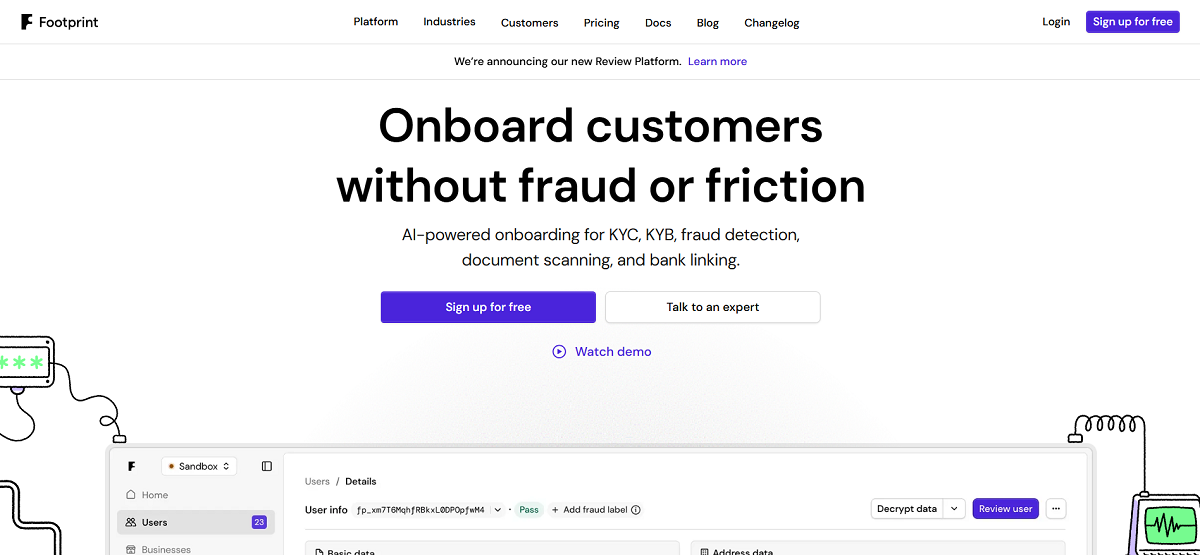
Footprint

Footprint is a modern identity verification and onboarding platform that supports both individual and entity-level onboarding. It emphasizes speed and usability to support identity verification and fraud prevention while keeping friction low for legitimate users.

In addition to standard document verification and identity checks, Footprint offers device binding, which attempts to link an identity to a specific physical device to prevent duplicate or synthetic identities. The platform offers customizable onboarding flows and risk-based, adaptive verification logic to adjust friction automatically.

Key Features:

  • Vault for secure, verified identity storage for reuse and compliance, so users don’t have to repeat verification checks
  • Integrates into existing workflows via Footprint’s user interface, SDK, or API
  • Offers de-duplication and identity-data de-duplication mechanisms to reduce fraud and duplicate accounts
  • Customizable data-collection steps for different use cases
  • Device binding to link identity to a specific physical device

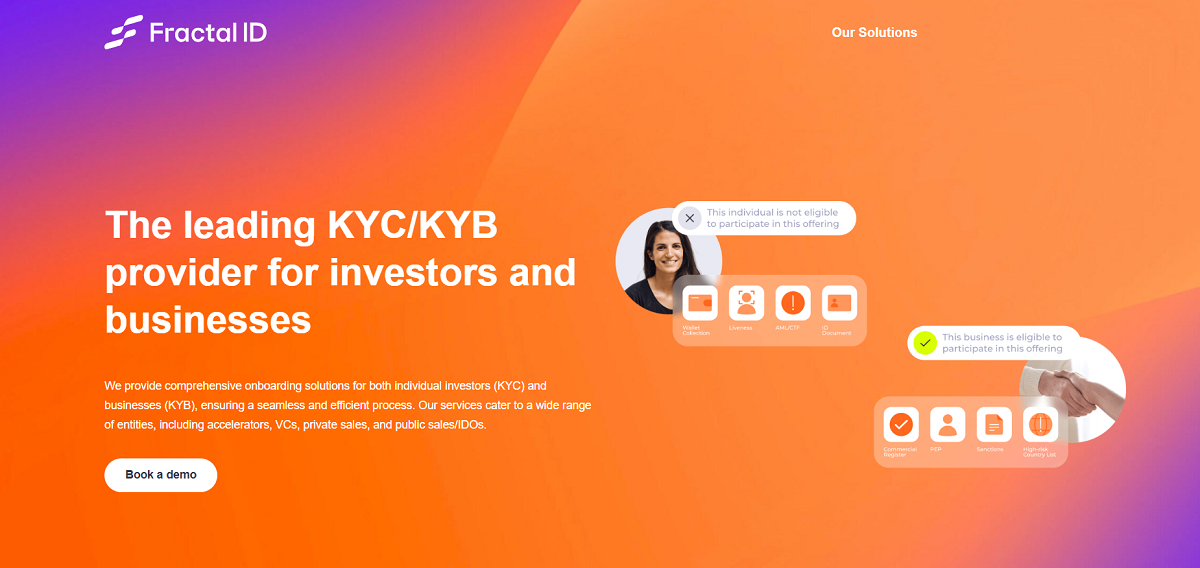
Fractal ID

Fractal ID is a digital identity and decentralized identity solution. It’s designed for Web3 and platforms that want identity verification without centralized storage of personal data. It combines KYC and AML compliance with human uniqueness checks to verify that every verified user represents a single real person. This helps to block Sybil attacks and fraud.

Fractal ID supports both individual and business verification. The platform has a decentralized identity storage model. This means that after verification, identity data is stored as encrypted verifiable credentials on a decentralized storage network (idOS) rather than held by Fractal. This decentralized approach reduces exposure to data breaches and privacy risks.

Key Features:

  • Selective disclosure controls that let users choose what data to share
  • Enables reuse of identity credentials across services without repeated KYC processes
  • Bridges Web2 compliance demands with Web3 privacy and decentralization
  • Flexible integration for Web3, blockchain projects, launchpads, and investor onboarding
  • Supports both compliance-driven workflows and privacy-first identity models

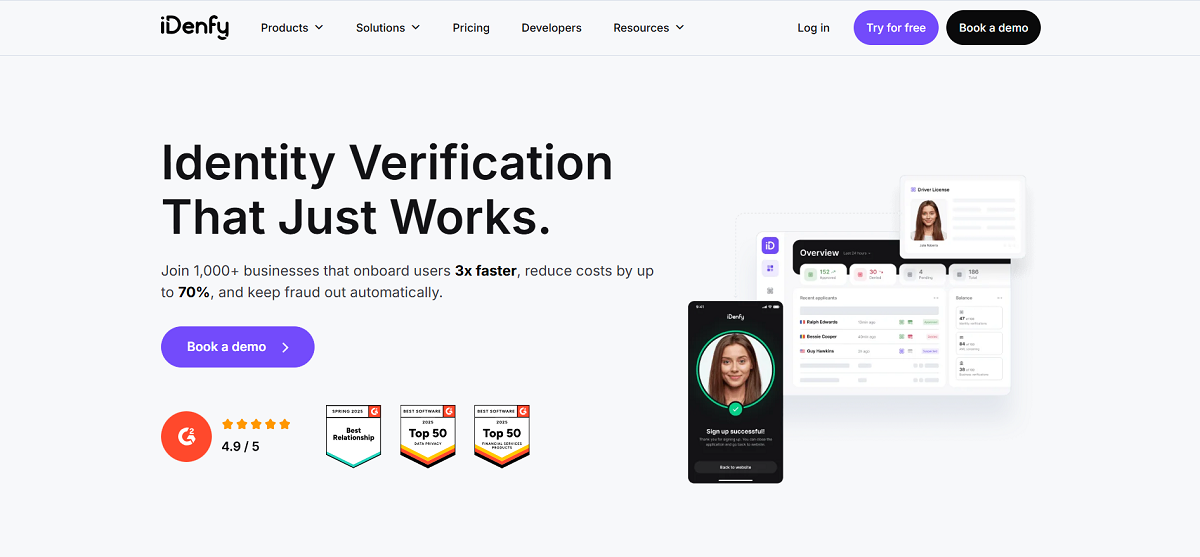
iDenfy

iDenfy is a digital identity verification and KYC and AML compliance platform. It supports remote onboarding, including screening for document authenticity. The platform offers broad global coverage, enabling it to extract data from thousands of document types issued worldwide.

In addition, iDenfy supports checks beyond identity, such as address verification and screening against watchlists. It can also generate risk scores if banks choose to build risk-based KYC workflows.

Key Features:

  • Recognizes and verifies more than 3,000 types of documents from over 200 countries
  • Facial recognition and liveness checks to confirm that the person is real and present
  • Risk profiling and fraud prevention; screens against watchlists and flags suspicious risk signals
  • API, mobile, SDK, web SDK, or iFrame integration options for easy integration into onboarding workflows
  • Dashboard and reporting tools for monitoring verification status and tracking risk scores

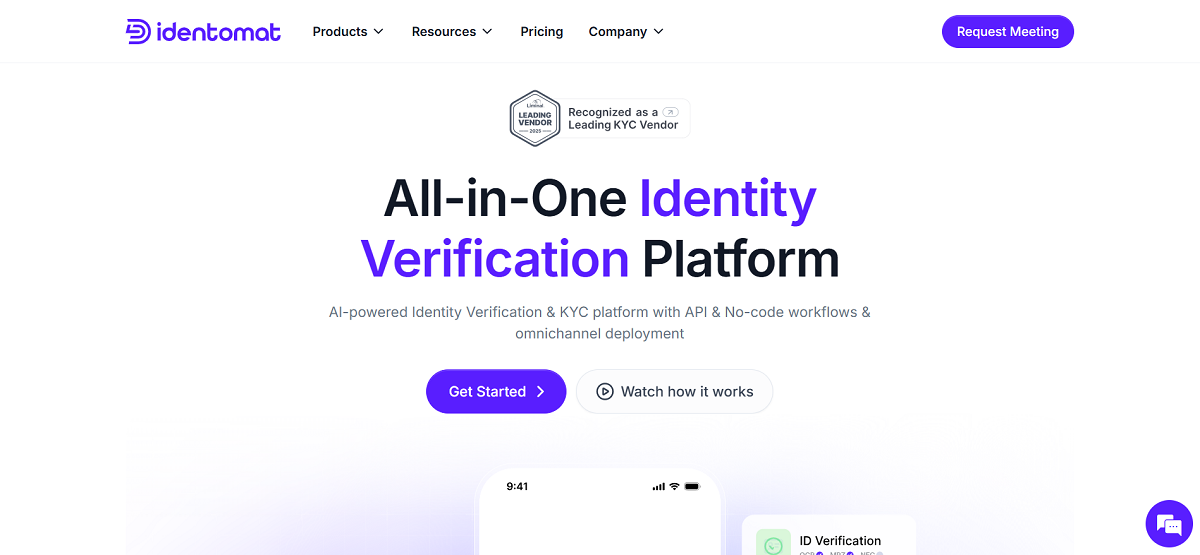
IDENTOMAT

IDENTOMAT is a KYC and AML compliance platform that supports thousands of government-issued ID types from many countries. Its fully remote onboarding capabilities eliminate the need for in-person verification. For cases requiring additional verification or operator review, IDENTOMAT offers Video-KYC, a live video call feature that supports human-in-the-loop or hybrid workflows.

It offers configurable workflows, including data collection questionnaires with conditional logic and custom fields. Additionally, IDENTOMAT can be deployed in the cloud or on-premises. A hybrid configuration is also possible. It can be integrated via SDK or REST API. iFrame integration and embedded workflows are also options.

Key Features:

  • Banks can tailor workflows and choose which modules to enable
  • Offers a balance between automation and human-in-the-loop verification for higher-risk clients or complex use cases
  • Supports thousands of document types across many jurisdictions
  • Modular, pay-per-verification pricing model that scales with volume
  • Ongoing AML monitoring with alerts for risk changes

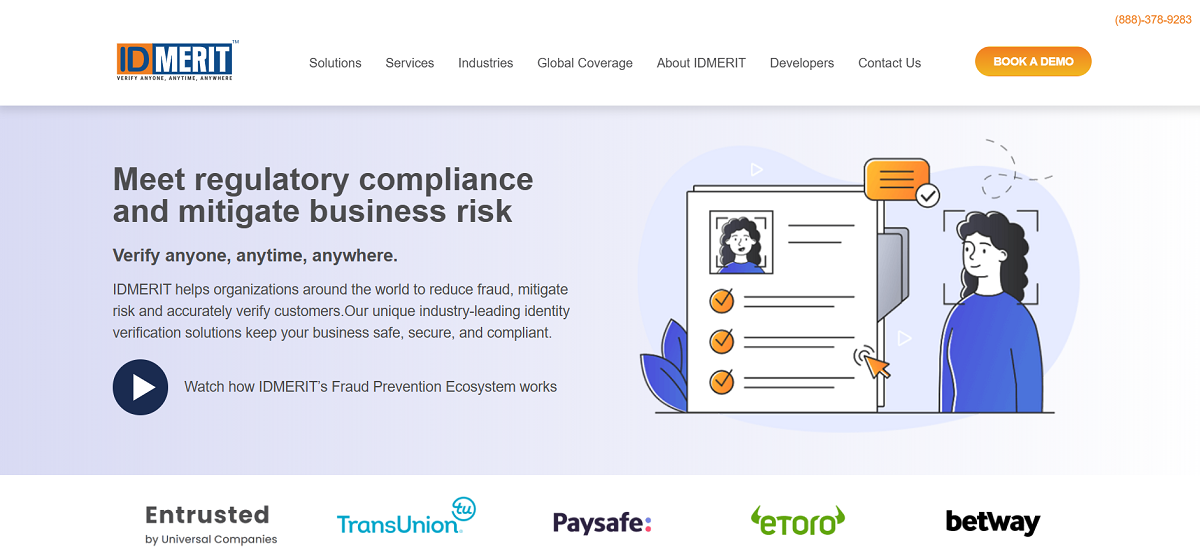
IDMERIT

IDMERIT is a global, API-first identity verification and compliance platform that offers real-time identity verification and business entity verification. The platform supports verification of many types of identity documents across more than 180 countries and jurisdictions, drawing on more than 440 official data sources.

IDMERIT’s IDMsocial and IDMdevice modules offer social data and device risk signals. These tools leverage non-traditional data sources such as social media and utility data to help verify difficult-to-verify customers or unbanked individuals.

Key Features:

  • Document verification with biometric face matching and liveness detection
  • Global ID verification across more than 180 countries and over 440 data sources
  • Social data and device risk signals to enrich data for difficult-to-verify customers
  • Support for age verification and regulatory compliance workflows
  • Coverage for many document types and multilingual identity datasets

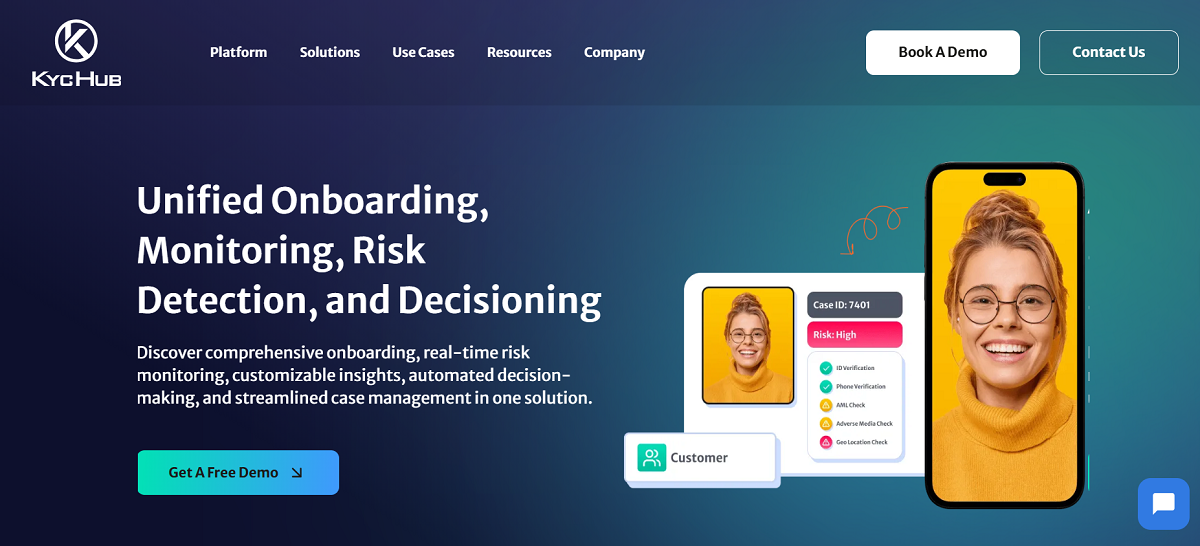
KYC Hub

KYC Hub is an end-to-end compliance platform that enables businesses to run identity verification for onboarding and monitoring in a single platform. It supports due diligence for both individuals and businesses. It also offers AML screening. With KYC Hub’s configurable, no-code platform, banks can customize workflows for a variety of use cases.

KYC Hub leverages more than 100,000 global data sources, with automated decisioning and case management to help teams manage flagged cases and reviews. It also supports robust reporting and audit trails for compliance.

Key Features:

  • Document-based identity checks and biometrics
  • Detects fraud and tampering, such as deepfakes and presentation attacks
  • Perpetual KYC and transaction monitoring to monitor customer behavior and risk signals
  • Modular platform with API-based integration to plug KYC Hub into onboarding flows or existing systems
  • Custom onboarding flows and questionnaires with conditional logic based on risk or jurisdiction

KYC-Chain

KYC-Chain is an all-in-one KYC platform for customer onboarding and lifecycle management with identity verification workflows and compliance tools. It supports onboarding for individuals and business clients and offers ongoing AML screening and crypto screening.

KYC-Chain’s flexible workflow and multi-scope onboarding enable banks and other institutions to set up different subsidiaries or business units in a unified compliance platform. This helps large and multi-entity organizations maintain organized onboarding streams for each division or group.

Key Features:

  • Document-based ID verification with biometric face match and liveness checks
  • Automated document authentication and OCR data extraction
  • Case management and compliance workflow tools, including reporting and auditing capabilities
  • Configurable onboarding workflows and customizable data-collection steps
  • Cloud-based platform with API integration options

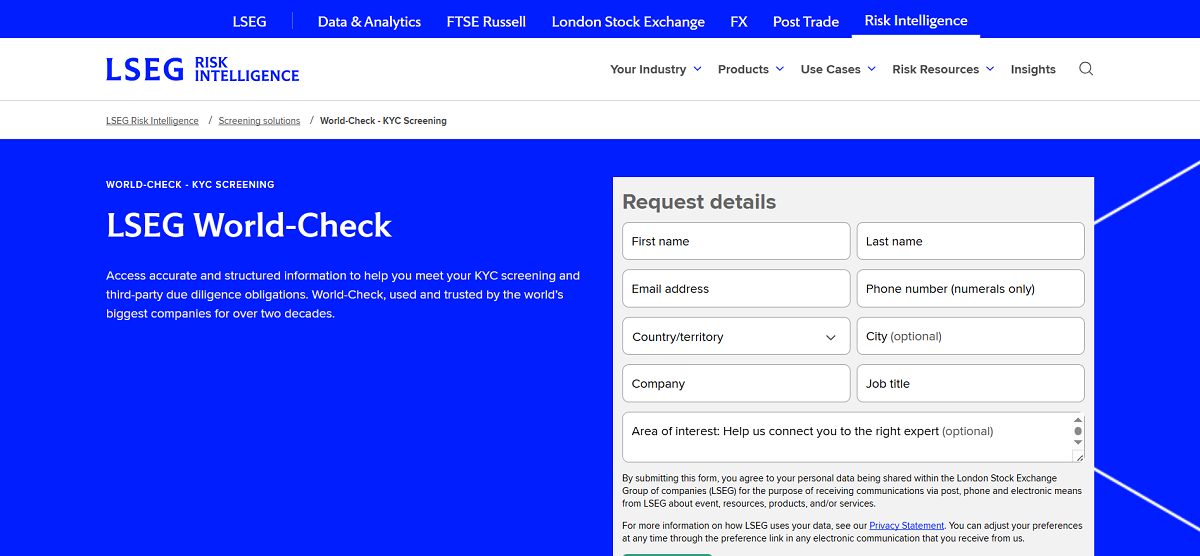
LSEG Risk Intelligence

LSEG Risk Intelligence is the compliance arm of the London Stock Exchange Group (LSEG). It delivers a global risk-intelligence database and screening tools for KYC and AML, including sanctions compliance and due diligence.

The platform’s flagship screening offering is World-Check, a large database of individuals and companies flagged for elevated risk. With World-Check On Demand and World-Check Verify, banks can embed screening into onboarding or transaction flows so risk checks don’t slow down operations.

Key Features:

  • Structured profiles that show risk indicators and source details
  • Ongoing monitoring that alerts teams when customer or entity risk changes
  • Options for individual and business screening across onboarding and third-party due diligence
  • API, data-feed, batch, and portal access for different workloads
  • Real-time screening through World-Check On Demand and World-Check Verify

MemberCheck

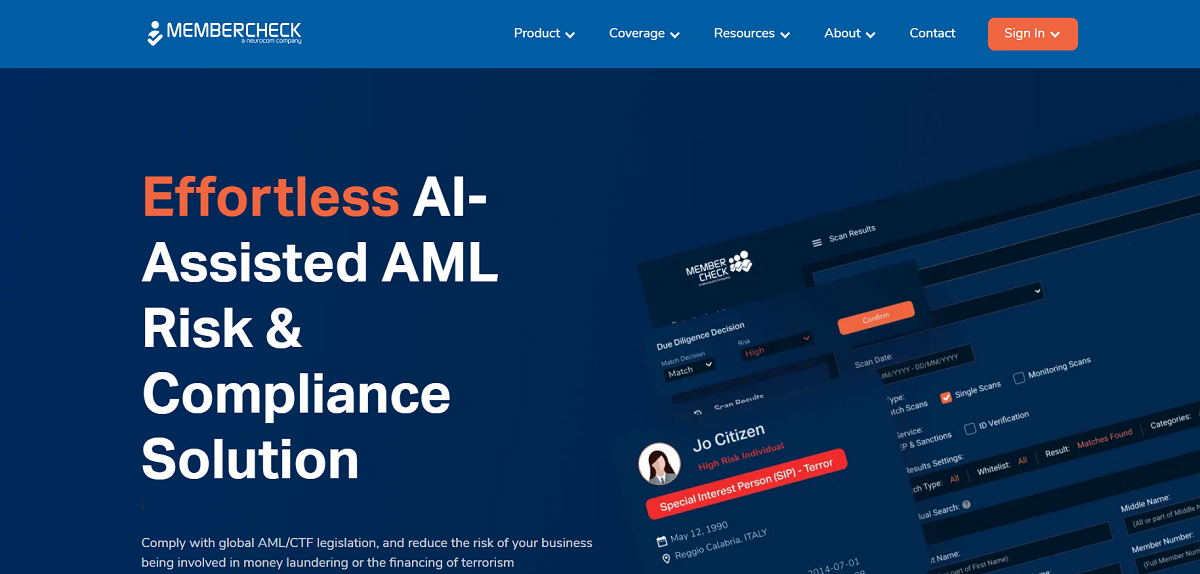
MemberCheck is an identity verification and AML compliance suite that supports screening and verification of both individuals and businesses. The platform offers monitoring and transaction screening. It also supports enhanced due diligence workflows for cases requiring closer attention.

MemberCheck offers customizable workflows, enabling banks to apply custom watchlists and blacklists. It also offers intelligent filters and fuzzy-matching logic to reduce false positives. MemberCheck can plug into existing systems via API. It can also be used through the MemberCheck user interface.

Key Features:

  • Ongoing monitoring with alerts when risk status changes
  • Transaction monitoring for suspicious activity
  • ID verification, biometrics, sanctions and watchlist screening, and adverse media screening
  • Custom watchlists and intelligent filtering to reduce false positives
  • API integration or web-portal access, depending on workflow needs

Middesk

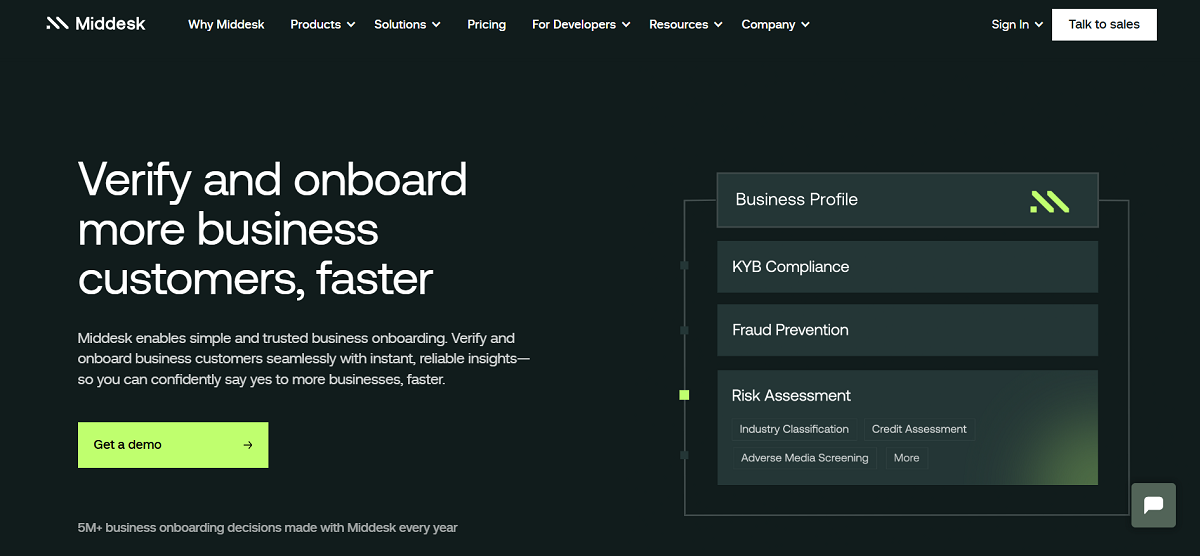
Middesk is a business identity verification and KYB platform that primarily serves U.S.-registered companies. It helps banks and other institutions verify and onboard business customers or partners. It also offers ongoing monitoring to detect changes that impact risk.

Middesk goes beyond simple verification. It helps banks assess if a business is potentially risky or illicit by checking for liens and bankruptcies, as well as litigation records. Its risk-scoring product, Middesk Signal, quickly evaluates business legitimacy and risk and assigns a score to support decision-making.

Key Features:

  • Instant access to U.S. Secretary of State records and business registration data
  • Retrieves official documents such as Certificates of Good Standing and Articles of Incorporation
  • Risk-scoring via Middesk Signal to automate business risk decisions
  • Ongoing monitoring for changes in business status or filings
  • API-first design with dashboard access for manual review

Ondato

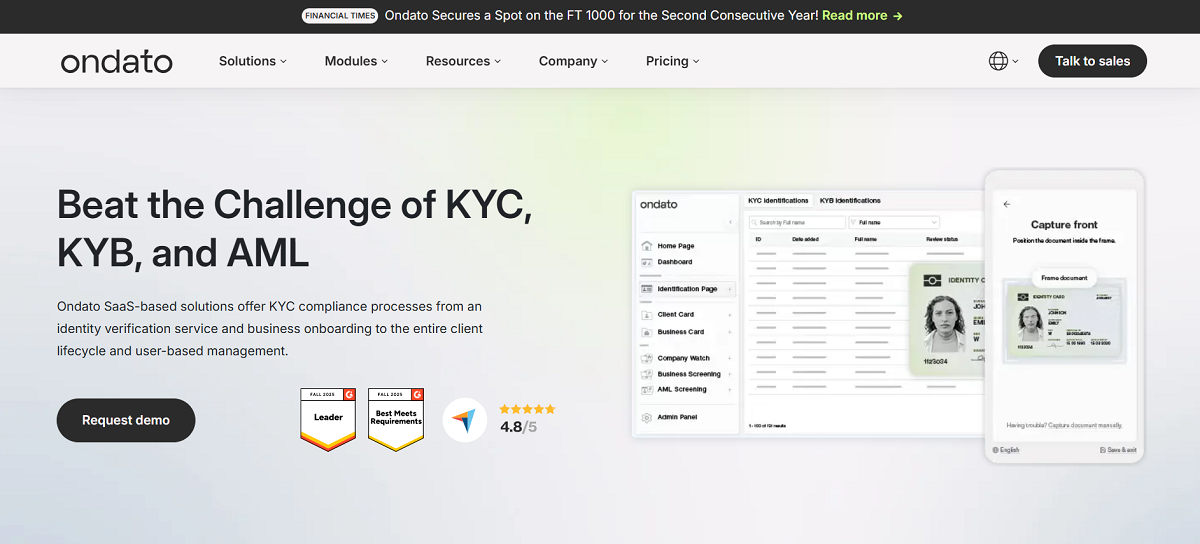
Ondato is a modular platform offering AML and KYC verification and due diligence tools for individuals and business clients (KYB). It offers multiple verification methods, including AI-driven document analysis and optical character recognition (OCR), to extract and validate data from identification documents. It supports thousands of document types from more than 190 countries.

The platform also offers near-field communication (NFC)-based verification that reads encrypted data from ID document chips. Ondato works with both direct integration and minimal-code deployment. In addition to API or SDK for web or mobile, it also supports integration via simple static link flows.

Key Features:

  • Multiple verification modes, including live video verification and NFC-based chip reading
  • Meets global data security and compliance standards, including GDPR and eIDAS
  • AI-powered identity verification, such as document verification with OCR and liveness detection
  • KYB onboarding to conduct entity due diligence, including identifying beneficial owners and mapping ownership structures
  • AML screening and monitoring, including watchlist screening against sanctions lists and PEPs, as well as adverse media screening

Persona

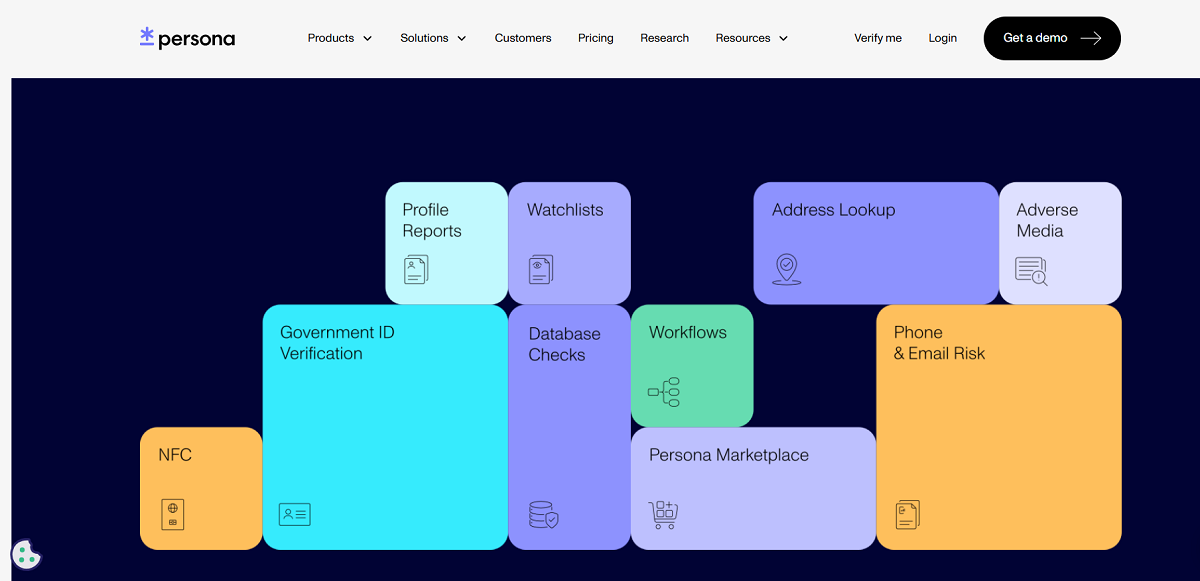
Persona is a cloud-based identity verification and compliance platform that helps banks verify individuals and businesses. The platform also offers lifecycle identity management. It’s designed to be flexible and configurable, enabling banks and other institutions to adapt verification flows and risk thresholds.

Persona uses a mix of signals to assess risk and detect suspicious or synthetic identities. The platform cross-checks user data against authoritative databases to enrich identity data and reduce reliance on document submission.

Key Features:

  • Configurable, modular verification workflows to customize which checks run and when
  • Reusable identity verification across platforms
  • Tools for manual review and investigations when automated checks flag risk
  • Fraud detection and adaptive risk assessment using documents and metadata combined with behavioral signals
  • Flexible integration via API, SDK, or hosted/no-code workflows for web and mobile

Plaid

Plaid is a financial data-connectivity platform that acts as a bridge between users’ bank accounts and the apps they want to use. Instead of every fintech app building its own integrations with thousands of banks, Plaid provides a unified way to connect to them. This enables fintech companies to focus on their product while still giving users real-time access to their financial data.

From that foundation, Plaid has expanded into identity verification. It provides tools that help businesses onboard users and run seamless financial workflows, including risk checks and payments. Plaid leverages data from multiple sources to verify user identities, including official identity documents and bank-linked data. It also uses device and digital signals, as well as photo verification and liveness checks.

Key Features:

  • Matches user-provided identity with data on file at their financial institution to confirm account ownership and reduce fraud risk
  • Screening includes risk signals beyond document verification, such as device data and IP addresses
  • Machine learning models for deep fraud and synthetic ID defenses, including duplicate identity detection
  • Reusable identity verification across Plaid-powered apps
  • API-first integration, with Plaid-provided endpoints for creating or fetching identity-verification sessions

Sanction Scanner

Sanction Scanner is a compliance and AML screening platform that offers watchlist and adverse media screening, including sanctions and PEP screening. It also offers risk scoring and ongoing transaction monitoring, all in a unified platform. It supports more than 3,000 domestic and international lists from over 220 countries.

Sanction Scanner leverages fuzzy matching and phonetic algorithms to identify name variants and transliterations. It can also recognize formatting differences and misspellings to reduce false negatives and control false positives. The platform logs screening history and decisions, providing compliance-ready audit logs and reporting.

Key Features:

  • Adverse media screening across global news, media, blogs, and public records
  • Transaction monitoring to flag suspicious payments or flows
  • Real-time, ongoing monitoring of customers and transactions
  • Risk scoring and customizable risk assessment workflows
  • API-driven integration for onboarding and compliance automation

SEON

SEON is a unified fraud prevention and AML compliance platform that combines fraud detection and risk scoring with transaction screening in a central system. It connects more than 900 first-party data signals, such as device and behavioral signals, and risk intelligence datasets.

With customizable and transparent rules, teams can define custom risk thresholds and adjust rules. This is augmented by machine-learning suggestions backed by transparency and human-readable logic. SEON also offers case management and investigative tools to help risk and compliance teams investigate cases efficiently.

Key Features:

  • Real-time risk scoring and decisioning deliver risk scores at signup, login, transaction, or checkout
  • Monitors user behavior and transaction flows for suspicious activity
  • Device intelligence and fingerprinting to detect bots or automated fraud
  • API-first design with modular components and fast onboarding
  • Case management and investigative tools, including audit-ready logs and team collaboration capabilities

Shufti Pro

Shufti Pro is a global, scalable identity-verification solution that supports more than 10,000 document types and over 150 languages across more than 230 countries and territories. It combines document verification and biometric checks with AML and risk screening, aiming to balance security with user convenience.

The platform is modular, meaning banks determine which checks they need, and it offers both API and SDK integration options. Shufti’s electronic identity verification (eIDV) cross-checks identity across government and official databases where available, enabling a document-free or lower-friction verification in some jurisdictions.

Key Features:

  • Flexible verification flows, including standard KYC and video KYC
  • Fast, automated processing, with many verifications completed within seconds to a minute
  • Banks can tailor verification flows and choose which checks to run
  • Shufti’s Fast ID is a reusable identity verification solution that can be used for future authentication or step-up verification without repeated document submission
  • Fraud prevention and risk monitoring tools to help identify suspicious behavior and tactics such as synthetic identities and spoofing

Socure

Socure is a digital identity verification and fraud prevention platform. It uses advanced data analytics and machine learning, along with trusted online and offline data intelligence, to verify individuals and businesses and detect identity fraud in real time. The platform’s risk-scoring and identity-risk analysis assigns risk or fraud scores to support automated decision-making while balancing risk and user experience.

Socure achieves 98% frictionless auto-approvals with broad population coverage, reducing manual reviews by 40%. The platform’s inclusive identity coverage enables it to verify difficult-to-verify populations, such as unbanked customers or those with thin files, by using alternative data beyond credit history and traditional identifiers.

Key Features:

  • Global ID document coverage across many countries and languages
  • KYC and AML compliance screening, including sanctions and watchlist checks
  • Device, email, phone, and IP intelligence for added fraud-defense signals
  • No-code and low-code workflow orchestration for fast integration
  • Continuous monitoring for changes in identity or fraud risk

Themis

Themis is an AI-powered KYC platform that aggregates data from global sources and proprietary datasets. It applies AI and automated logic to screen individuals and businesses, including suppliers and counterparties, against risk data sources.

Themis supports digital onboarding with flexible workflows and customizable approval and review steps. After onboarding, Themis offers ongoing monitoring with alerts when the customer’s risk status changes.

Key Features:

  • Risk-scoring model that helps banks quickly assess and prioritize risks
  • Scalable and flexible to meet the needs of small banks doing occasional checks and large global institutions that need high-volume KYC
  • Supports deeper, human-led enhanced due diligence when needed
  • Comprehensive risk coverage, including sanctions, watchlists, adverse media, litigation, corporate registries, and convictions, for a broad view of financial-crime risk
  • Ongoing monitoring and alerts for changes in risk status

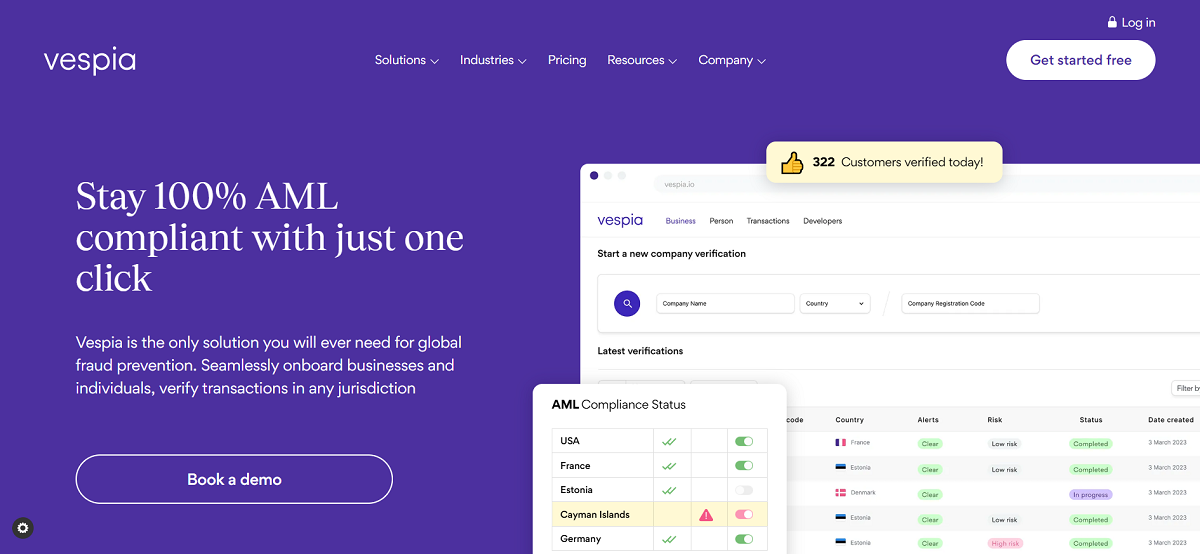
Vespia

Vespia is an AI-powered KYC and AML platform that offers onboarding and continuous monitoring across more than 300 jurisdictions. It combines data from global company registries with more than 4,000 global risk lists (including sanctions and PEP watchlists) and adverse media sources. This data supports Vespia’s identity-verification capabilities.

Vespia offers a risk-scoring engine that blends rule-based logic and AI, plus an “AI-powered Compliance Officer” to help interpret risk and compliance results. It offers flexible integration options via API or SDK. There’s also a web dashboard/widget for onboarding and verification, useful for banks that want to embed checks directly into apps or processes. As part of its broader AML offering, Vespia also provides transaction monitoring tools.

Key Features:

  • Ongoing monitoring and alerts for changes in UBO, corporate structure, updated sanctions or PEP watchlists, adverse media hits, expired documents, suspicious activity, and other triggering events
  • Transaction monitoring tools to watch for suspicious behavior as part of Vespia’s broader AML offering
  • Pre-built KYC and KYB templates and jurisdiction-based workflow logic
  • Generates compliance-grade reports and maintains audit trails for due diligence and regulatory reporting
  • Flexible integration via API, SDK, or a web dashboard/widget for onboarding and verification

Enhance your bank’s KYC processes with OSINT


Traditional KYC software platforms do a solid job with identity verification and standard checks. They confirm that the records align and keep banks in compliance with regulations. However, they often rely on what the individual or business chooses to report, leaving blind spots.

ShadowDragon® Horizon® eliminates those blind spots by pulling in real-world activity, such as open records and breach data. That gives your team a view of how customers behave outside of forms and static databases.

During onboarding, Horizon® Identity helps you verify the story behind the documents. The platform builds around a single data point, such as email or username, and creates a complete identity profile. The profile may show normal, consistent activity that matches the application. Or it might reveal signs of a synthetic identity or an extremely sparse history for an individual. It can also reveal reused credentials or odd clusters of accounts that share the same details.

Horizon® can also help with complex ownership. Link analysis can surface hidden ties to risky partners or undisclosed individuals with significant control over a company. You can see when an applicant who otherwise appears clean is just one or two steps away from sanctioned individuals or high-risk entities. It can also reveal links to known fraud rings. This context supports better decision-making on enhanced due diligence and onboarding exceptions.

KYC doesn’t end at account opening. Horizon Monitor® supports perpetual KYC by monitoring customer identifiers and keywords across open sources. When something changes, your team receives an alert. Changes such as new adverse media or sudden spikes in risky activity can reveal new risks.

Together, ShadowDragon® Horizon®, Horizon® Identity, and Horizon Monitor® give your bank a wider field of view. Your KYC platform handles structured checks and regulatory rules. ShadowDragon® adds real-world context from publicly available sources. Contact our team for a demo today to learn how ShadowDragon® can help your teams identify risk earlier and build stronger cases for every decision.

Frequently asked questions

How is KYC software different from AML software?

The goal of KYC is to determine who the customer is and whether they pose a risk before and after onboarding. AML looks at what the customer does over time. AML tools monitor transactions and behavior for suspicious activity. Most platforms combine KYC and AML capabilities into a single system.

Which regulations do KYC platforms help banks comply with?

KYC platforms help banks align with laws and guidance issued by regulatory and government authorities. For example, the Financial Action Task Force (FATF) and FinCEN, as well as the Office of Foreign Assets Control (OFAC) and the AMLA (Authority for Anti-Money Laundering and Countering the Financing of Terrorism).

In the U.S., regulations include the Bank Secrecy Act (BSA) and FinCEN’s Customer Due Diligence and Beneficial Ownership requirements. The EU Anti-Money Laundering (AML) Directives apply to the European Union, and in the UK, banks must comply with the UK Sanctions and Anti-Money Laundering Act. Most jurisdictions base their AML and KYC rules on the FATF Recommendations (these are considered the global standard).

Do KYC platforms replace human compliance analysts?

KYC platforms don’t replace human analysts but rather are intended to help teams work smarter. KYC platforms reduce manual work and surface better data, but ultimately, human analysts are still responsible for judgment calls.

How do KYC platforms reduce false positives?

The best KYC platforms use better data along with risk scoring and configurable rules. Instead of basic name matches and watchlist screening, the strongest platforms check multiple signals. This helps filter out noise and identify the real risks, which helps reduce low-value alerts being sent to the analyst.